Field notes from on-site captures and explorations. A mix of locations, gaussian splatting observations and experiments documenting the process of scanning real environments.
SAMPLE(S) est une archive navigable du Sample, tiers-lieu de Bagnolet, reconstituée par Gaussian Splatting avant la fermeture du lieu en juin 2026. Plus de trente espaces capturés — ateliers, tunnel, jardin, salle de concert — navigables en temps réel sous Unreal Engine.
Waiting screen
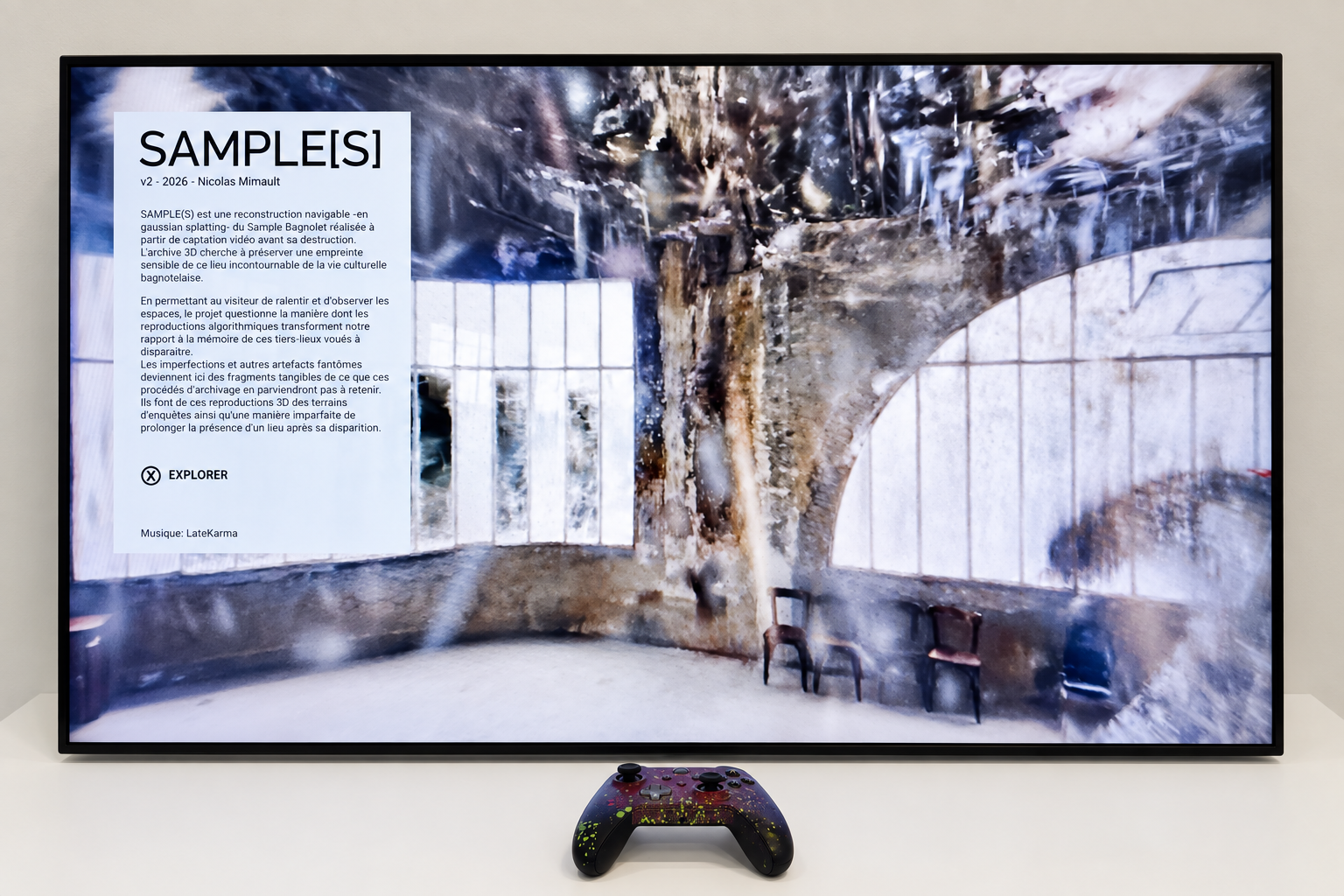
Une caméra cinématique se déplace en temps réel à travers les espaces de l’archive — travelling automatique dans les scènes GS en patchwork. C’est l’écran d’accueil du dispositif, le temps que le visiteur commence à jouer. La vidéo ci-dessous en est une capture.
SAMPLE(S) — Waiting screen — Le Sample, Bagnolet, juin 2026 — Music: LateKarma
Gameplay — 30+ scènes
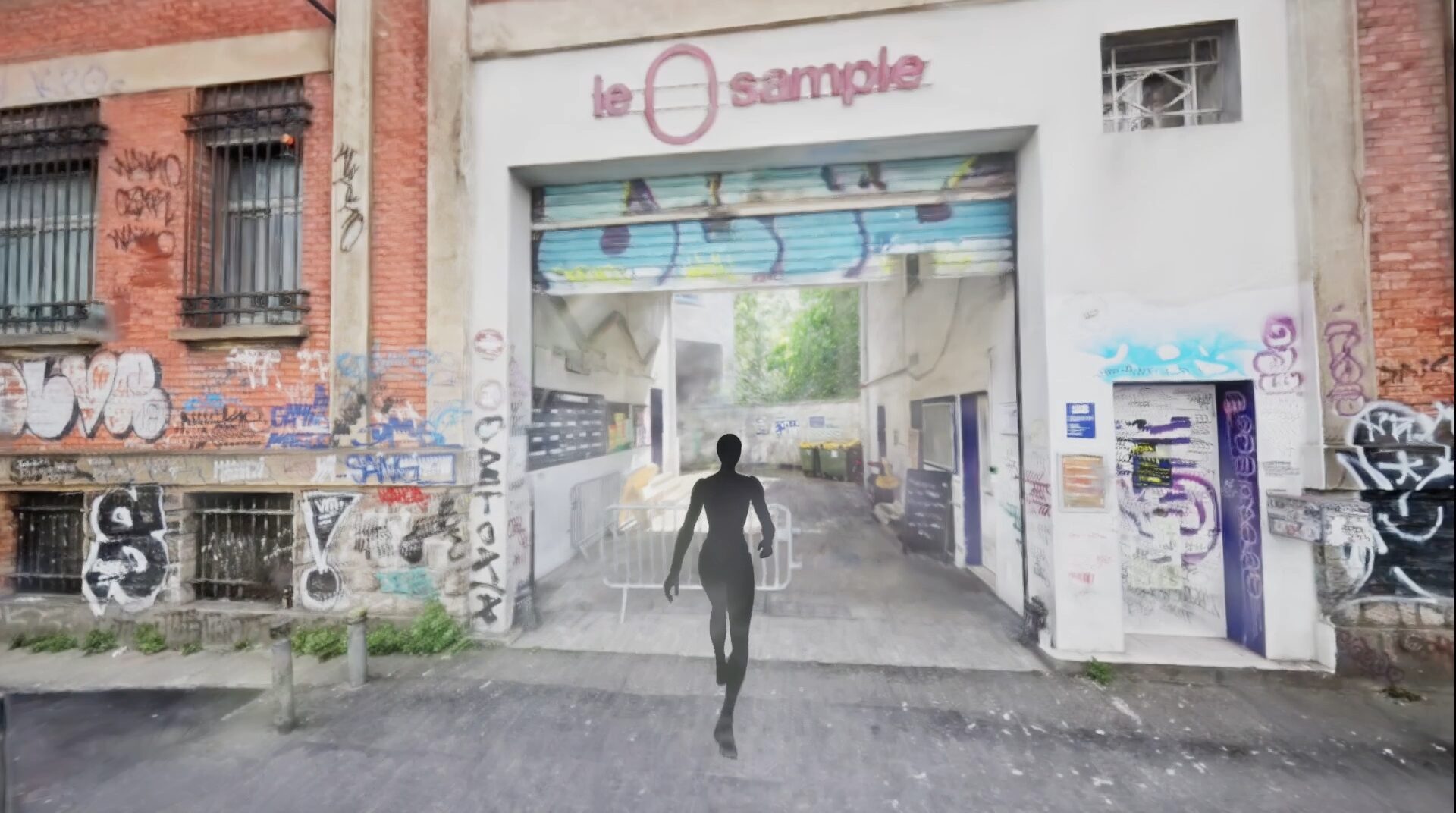
Dix minutes de navigation à travers l’ensemble des espaces capturés. L’avatar traverse le lieu de l’entrée aux ateliers, du tunnel au jardin. Chaque scène est une reconstruction distincte, reliée aux autres par un système de portails.
SAMPLE(S) — Full gameplay, 30+ scenes — Le Sample, Bagnolet, juin 2026 — Music: LateKarma
SAMPLE(S) is a navigable archive of Le Sample, a cultural venue in Bagnolet, reconstructed using Gaussian Splatting before the venue closed in June 2026. 30+ spaces captured — studios, tunnel, garden, concert hall — navigable in real time inside Unreal Engine.
Waiting screen
A cinematic camera moves through the archived spaces in real time — an automatic travelling across GS scenes in patchwork. This is the device’s welcome screen, displayed while waiting for the visitor to start playing. The video below is a screen capture of this sequence.
Gameplay — 30+ scenes
Ten minutes of navigation through all captured spaces. The avatar moves through the venue from the entrance to the studios, from the tunnel to the garden. Each scene is a distinct reconstruction, connected to the others through a portal system.
Part of an ongoing research on navigable volumetric reconstructions and the limits of algorithmic capture.
Notes d’exposition — Le Sample, Bagnolet, juin 2026
→ English below
Le Sample a fermé ses portes le 20 juin. L’exposition finale des résidents a duré trois semaines, du 4 au 20 juin. SAMPLE(S) y était présenté dans sa version la plus complète à ce jour : une trentaine de scènes reconstituées par Gaussian Splatting, navigables en temps réel sous Unreal Engine. Des ateliers d’artistes, des espaces communs, la salle de concert, le jardin.
Visiteur au dispositif — Exposition SAMPLE(S), Le Sample, Bagnolet, juin 2026
Voici quelques premières observations.
Le poids de la disparition
« Où est mon atelier ? », « c’est trop précieux d’avoir ça », « oh, tu as fait cet espace aussi !? » autant de réactions qui disaient moins l’intérêt pour le dispositif que le soulagement d’avoir une trace pour les résidents du Sample.
Cette archive n’était pas seulement un objet de curiosité technique. Ce que les utilisateurs cherchaient d’abord, c’était vérifier les limites de l’archive par rapport à leur connaissance du lieu : ce qui avait été capturé ou non, ce qui était encore là retrouver une affiche, un flyer, un détail. La charge affective d’un lieu qui disparaît change complètement le rapport à sa reproduction algorithmique.
Deux publics, deux expériences
L’écart entre ceux qui connaissaient le lieu et ceux qui ne le connaissaient pas était visible dans la façon de se déplacer. Les résidents allaient directement vers leur atelier, leur coin, leur espace. Les visiteurs extérieurs faisaient de même: ils se dirigeaient d’abord vers les lieux qu’ils venaient de traverser physiquement (entrée, salle de prog, jardin, jusqu’à la salle d’exposition du dispositif), l’installation étant exposée dans les espaces qu’elle reconstituait.
Cette différence confirme une des hypothèses du projet : l’expérience de l’archive navigable diffère selon qu’on a vécu ce lieu ou non. Pour les uns, c’est une résurgence mémorielle. Pour les autres, une découverte potentielle d’un espace. Il a été intéressant de noter que certains visiteurs ont d’abord découvert le lieu par sa transformation algorithmique et ont été décontenancés par cette impression de déjà-vu pendant la visite du lieu réel.
Enfants au dispositif — Exposition SAMPLE(S), Le Sample, Bagnolet, juin 2026
La manette et la navigation spatiale comme barrière
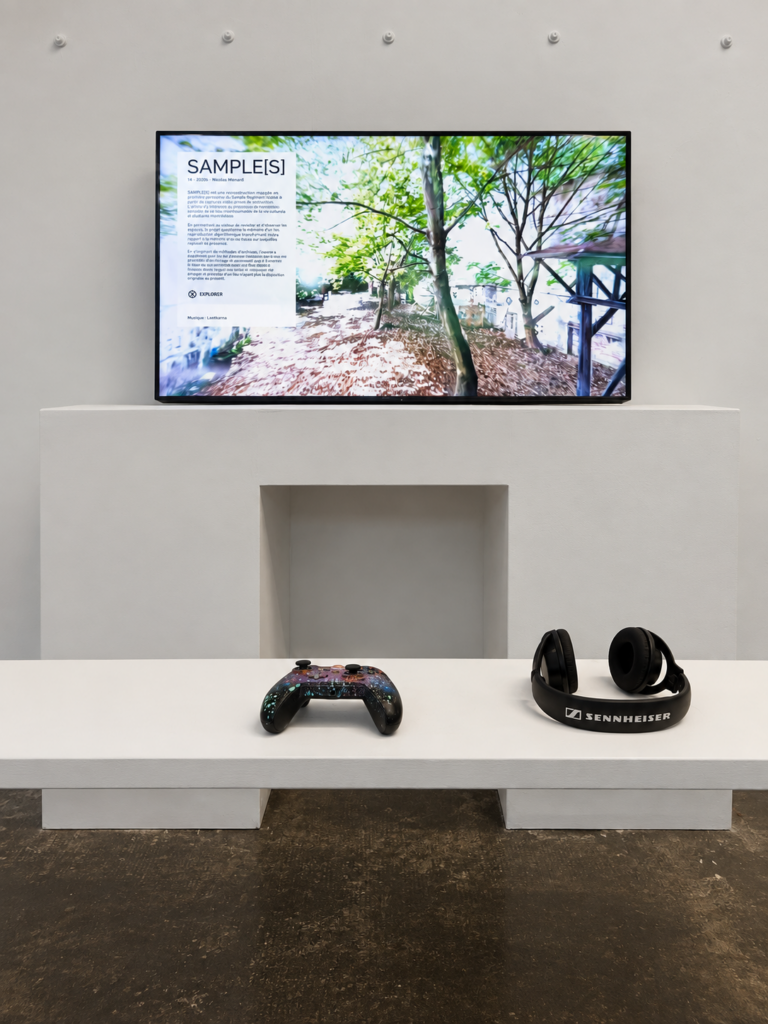
Un point que je n’avais pas suffisamment anticipé : la manette de jeu représente une barrière réelle à l’entrée. Ceux qui n’ont pas l’habitude des jeux vidéo peinent à se déplacer, regardent leurs mains plutôt que l’écran, abandonnent rapidement, par frustration ou par honte. « Je ne vais pas réussir », « je ne joue pas aux jeux vidéo », « ne me jugez pas ».
Les enfants, eux, même si la navigation est parfois difficile et qu’il n’y a pas de gamification, s’en emparent immédiatement.
Les « erreurs » de trajectoire et de contrôle de la caméra créent des vues improbables, personnage qui navigue en contre-plongée totale, angles impossibles. Une forme de déambulation involontaire qui produit ses propres révélations.
Si la déambulation et l’observation sont le principe de connaissance central du projet, qu’est-ce qu’on perd quand ce geste est bloqué par l’outil qui le permet ?
Visiteurs au dispositif — Exposition SAMPLE(S), Le Sample, Bagnolet, juin 2026
Ce que les gens cherchent
Les visiteurs, résidents ou non, cherchent d’abord à parcourir les espaces plus qu’à les observer. Ils veulent aller quelque part, comprendre la déambulation possible dans l’archive. Mais ce qui les interpelle ensuite, ce sont les imperfections (les glitchs, les zones floues, les déformations ) qui font apparaître la technique elle-même. « C’est dommage qu’on ne puisse pas prendre plus de recul par rapport à l’objet. » L’archive navigable appelle une forme de mobilité qui va de pair avec des questionnements techniques.
Ce que ça ouvre
Ce que révèle la déambulation dans une empreinte algorithmique, c’est d’abord la relation affective au lieu, avant même que commence l’enquête sur ce que l’algorithme en a retenu ou effacé.
La prochaine étape est d’appliquer cette approche de navigation 3D dans des reproductions algorithmiques à un terrain que je ne connais pas : en septembre, je rejoins le musée national estonien pour travailler avec leurs archives photographiques. Un lieu que je n’ai jamais habité, une collection que je ne connais pas. Ce sera l’occasion d’explorer ce que la transformation algorithmique d’une photographie en espace navigable révèle quand on n’a pas de souvenirs de ce lieu — qui a peut-être déjà disparu.
EN
Exhibition notes — Le Sample, Bagnolet, June 2026
Le Sample closed on June 20th. The final residents’ exhibition ran for three weeks, from June 4th to 20th. SAMPLE(S) was presented in its most complete version to date: around thirty scenes reconstructed using Gaussian Splatting, navigable in real time under Unreal Engine. Artists’ studios, shared spaces, the concert hall, the garden.
Here are some initial observations.
The weight of disappearance
“Where is my studio?”, “it’s so precious to have this”, “oh, you did this space too!?” — reactions that spoke less to interest in the device than to the relief of having a trace.
This archive was not merely an object of technical curiosity. What users looked for first was to verify the limits of the archive against their own knowledge of the place: what had been captured or not, what was still there — finding a poster, a flyer, a detail. The affective weight of a disappearing place completely changes one’s relationship to its algorithmic reproduction.
Two publics, two experiences
The gap between those who knew the place and those who didn’t was visible in the way they moved. Residents went straight to their studio, their corner, their space. Outside visitors did the same — they first headed toward spaces they had just physically passed through, the installation being exhibited within the very spaces it reconstructed.
This confirms one of the project’s hypotheses: the experience of the navigable archive differs depending on whether one has lived in the place or not. For some, it is a memorial resurgence. For others, a potential discovery of an unknown space. Notably, some visitors first encountered the place through its algorithmic transformation, and felt a strange sense of déjà-vu when visiting the real space afterward.
The controller as barrier
Something I hadn’t sufficiently anticipated: the game controller represents a real barrier to entry. Those unfamiliar with video games struggle to move through the space, look at their hands rather than the screen, and give up quickly — out of frustration or embarrassment. “I’m not going to manage”, “I don’t play video games”, “don’t judge me”.
Children, on the other hand, immediately take hold of it — even without gamification, even when navigation is difficult. Their “errors” in trajectory and camera control produce improbable views: characters navigating in full counter-angle, impossible perspectives. A form of involuntary wandering that generates its own revelations.
If wandering and observation are the central knowledge-producing gestures of the project, what do we lose when those gestures are blocked by the tool that enables them?
What people are looking for
Visitors — residents or not — first seek to move through spaces rather than observe them. They want to go somewhere. But what catches their attention next are the imperfections: the glitches, the blurred zones, the distortions that make the technique itself visible. “It’s a shame you can’t step back further from the object.” The navigable archive calls for a form of mobility that goes hand in hand with technical questioning.
What this opens
What wandering through an algorithmic imprint reveals is, first of all, an affective relationship to a place — before the inquiry into what the algorithm retained or erased even begins.
The next step is to apply this approach to a terrain I don’t know: in September, I join the Estonian National Museum to work with their photographic archives. A place I have never inhabited, a collection I don’t know. An opportunity to explore what the algorithmic transformation of a photograph into a navigable space reveals when one has no memory of the place — which may have already disappeared.
Part of an ongoing research on navigable volumetric reconstructions and the limits of algorithmic capture.
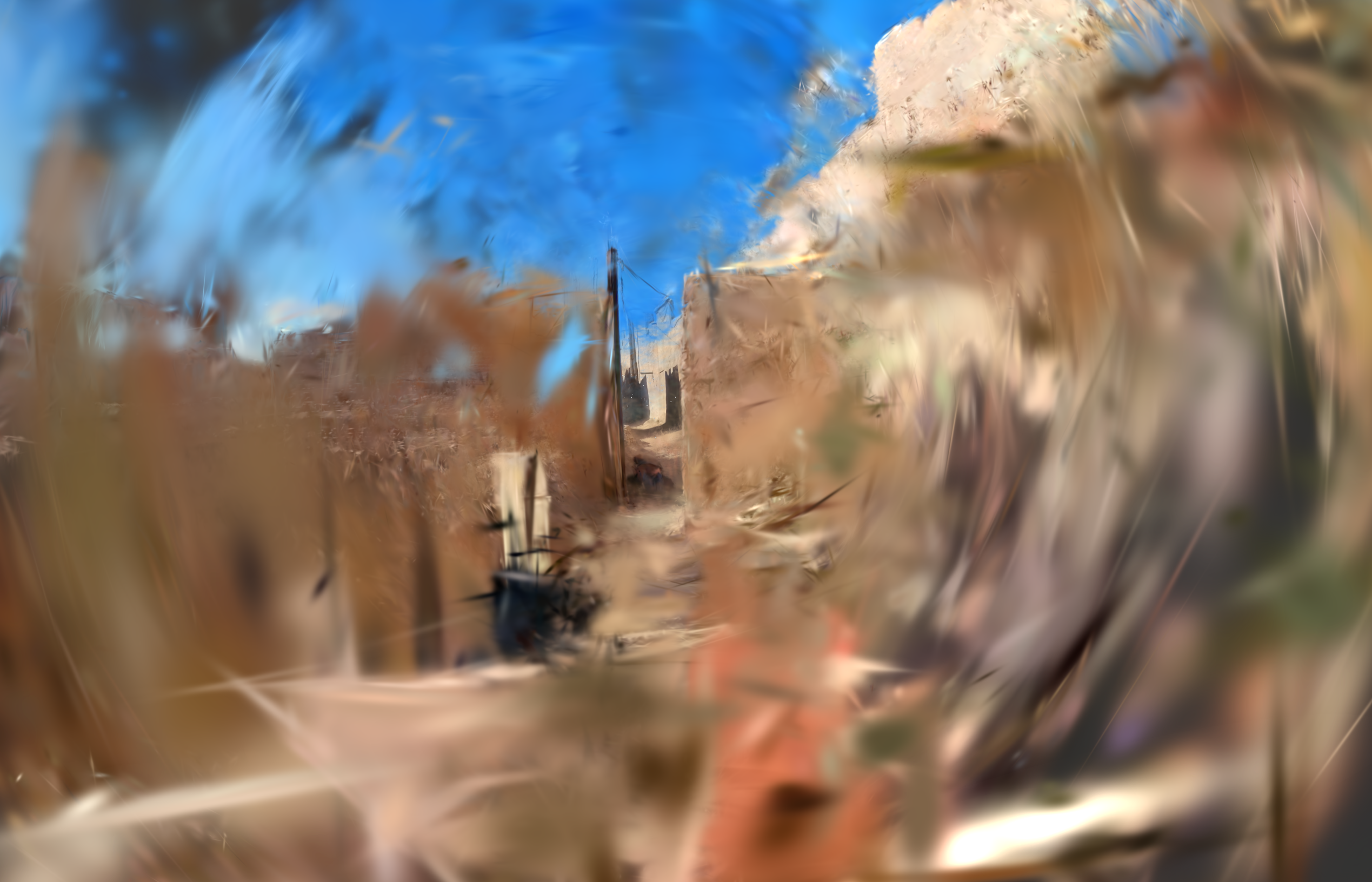
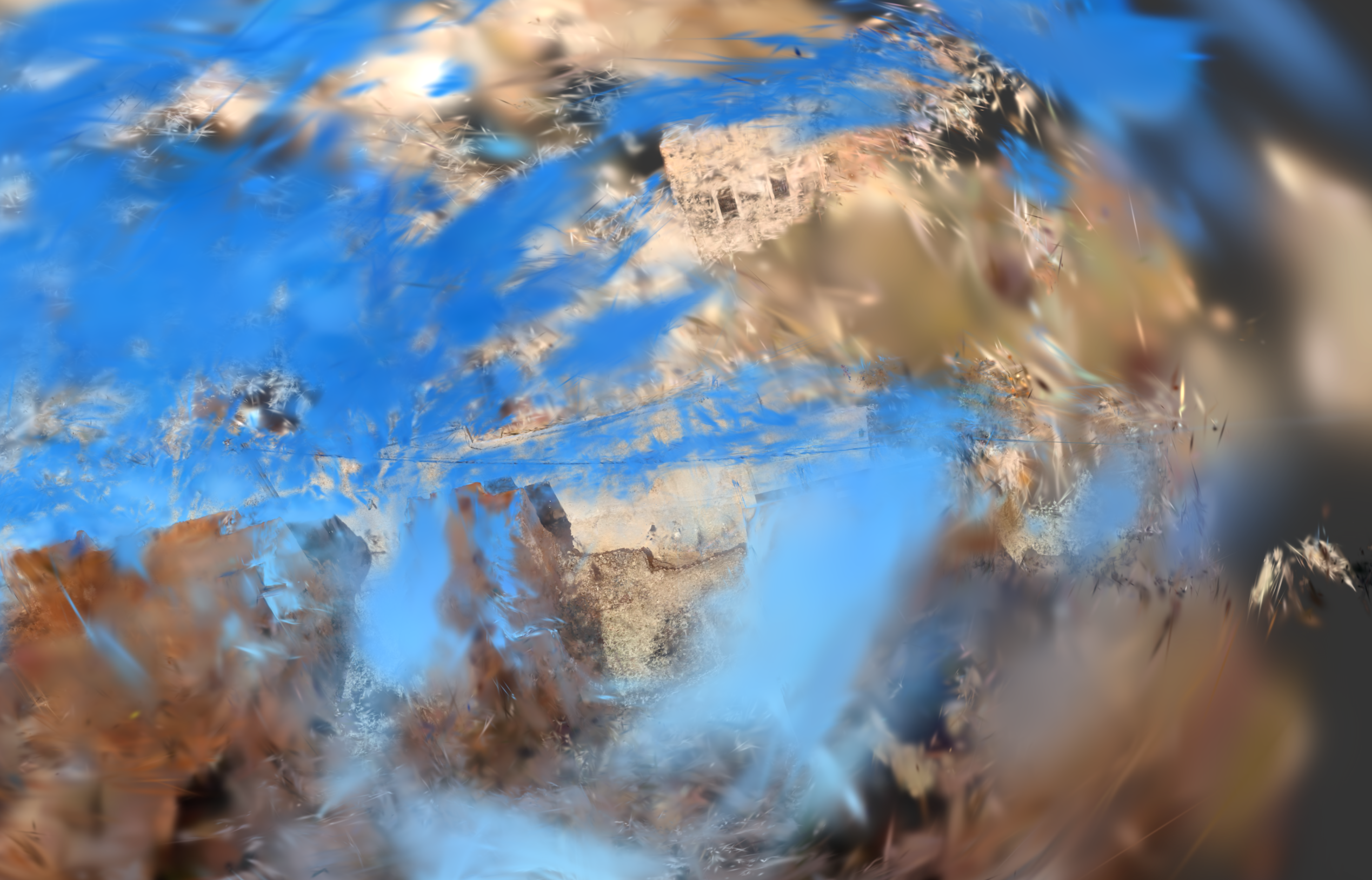
Le Gaussian Splatting reconstruit un lieu depuis un point de vue calculé. En dehors de la zone d’intérêt, une autre structure apparaît : un champ de particules arrangées pour simuler profondeur et parallaxe. Ce que l’algorithme ne parvient pas à représenter révèle son mode de fonctionnement.
—
Gaussian Splatting reconstructs a place from a calculated viewpoint. Outside the intended zone, another structure appears: a field of particles arranged to simulate depth and parallax. What the algorithm fails to represent reveals how it works.
1 — Out of frame
Abstract capture — out of field of interest | Unreal Engine Music: Ryuichi Sakamoto — disintegration (async)
Navigation dans la reconstruction d’une ruelle de Kasbah. Au passage de la caméra, l’espace se déforme et révèle progressivement sa structure sous-jacente. Les splats se dispersent jusqu’à l’abstraction totale.
—
Drifting through a reconstructed Kasbah alley. As the camera moves, the space deforms and begins to reveal its underlying structure. Splats scatter into full abstraction as the camera sinks into the ground.
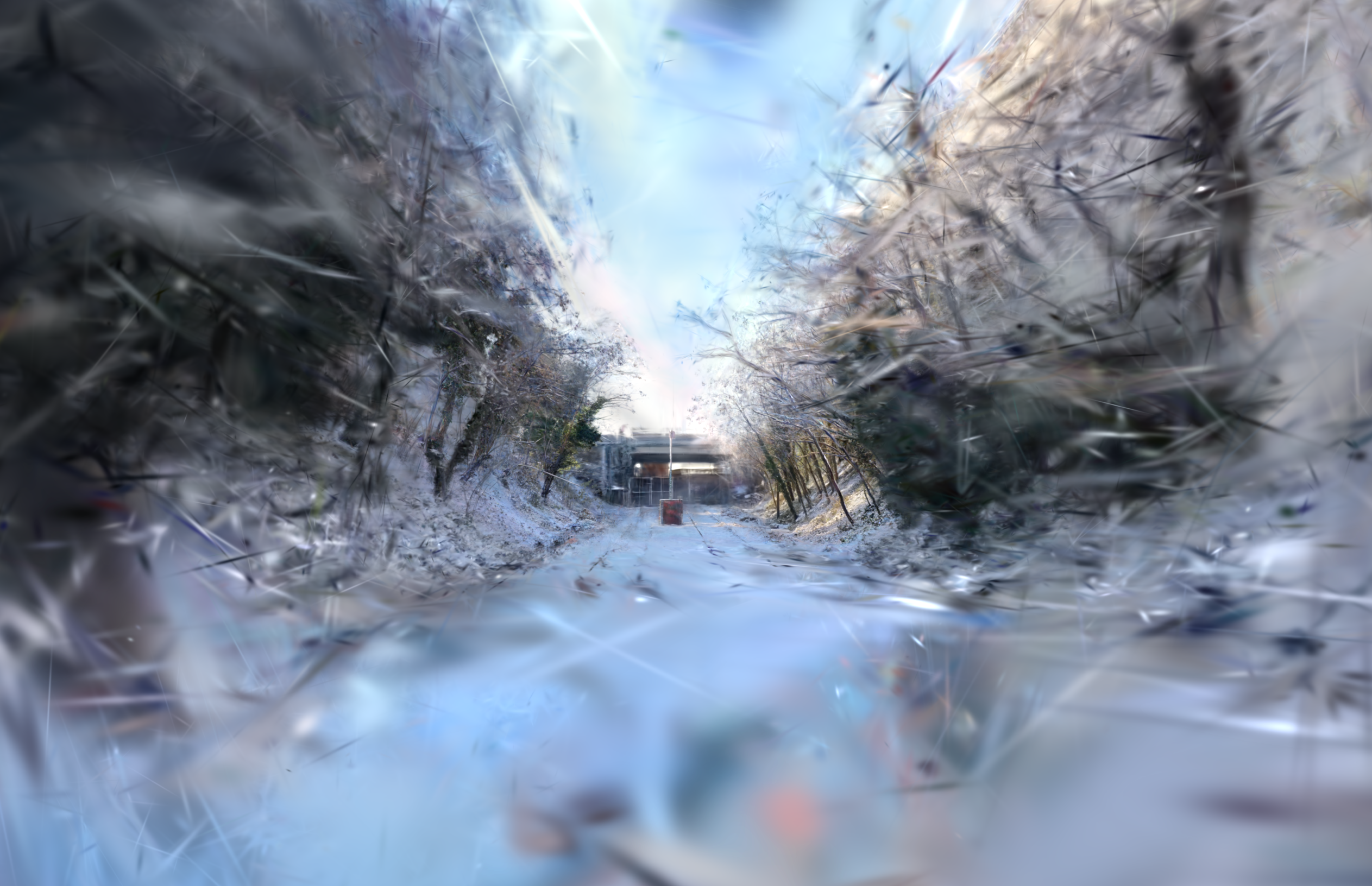
Field notes — Petite Ceinture, January 2026 Paris, 12e arrondissement — 06.01.2026
Navigation dans un environnement Gaussian Splatting reconstruit sous Unreal Engine. Des forces de particules interagissent avec le passage de la caméra, révélant la structure du radiance field. Les splats se dispersent comme des fragments que la mémoire peine à retenir. Une exploration en temps réel sur l’ancienne voie ferrée parisienne de la Petite Ceinture, sous la neige.
Navigating through a Gaussian Splatting environment in Unreal Engine. Particle forces interact with the camera’s passage, revealing the structure of the radiance field. Splats scatter like fragments we struggle to hold onto. A real-time exploration of the old Parisian railway, the Petite Ceinture, under snow.