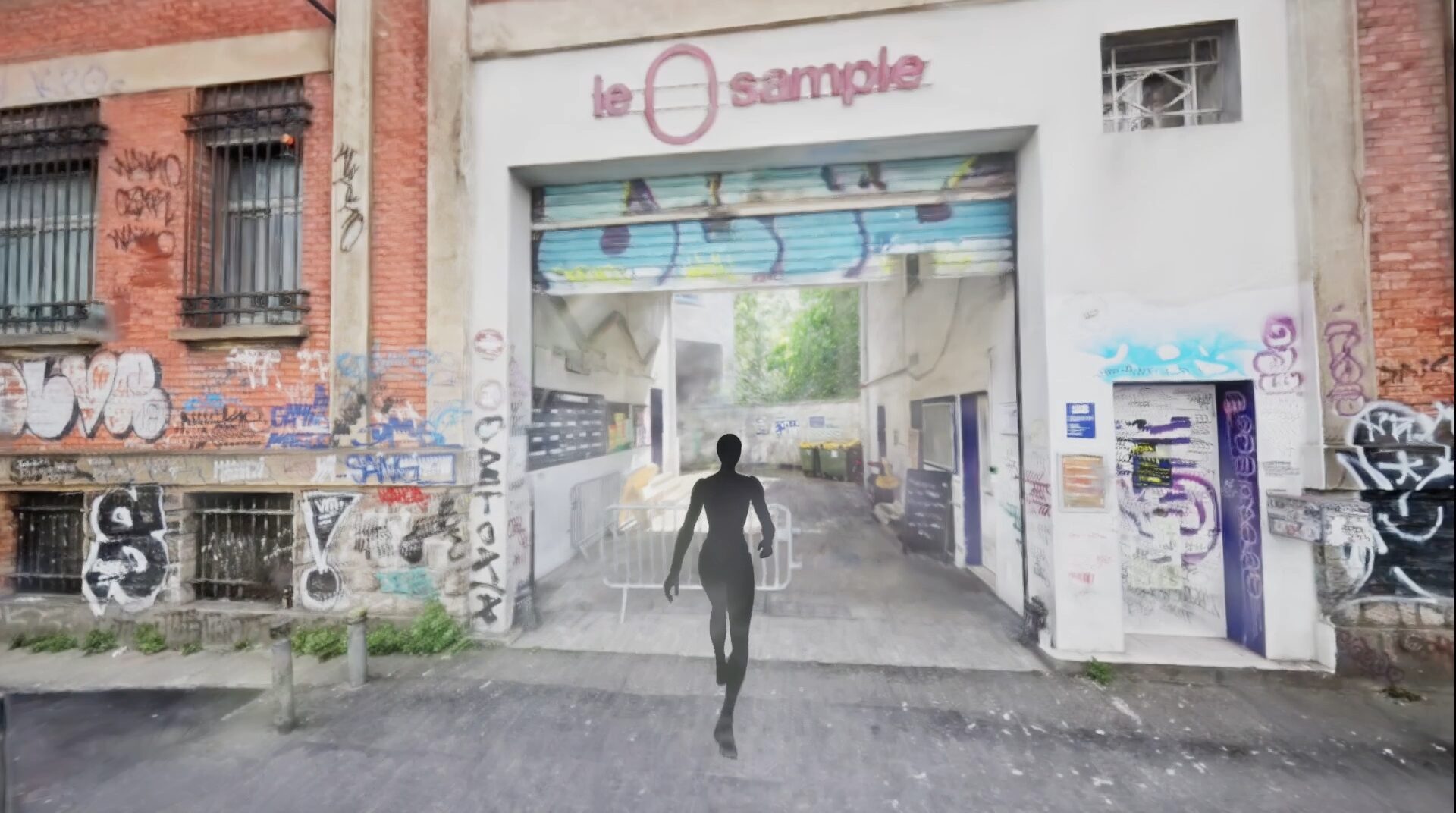
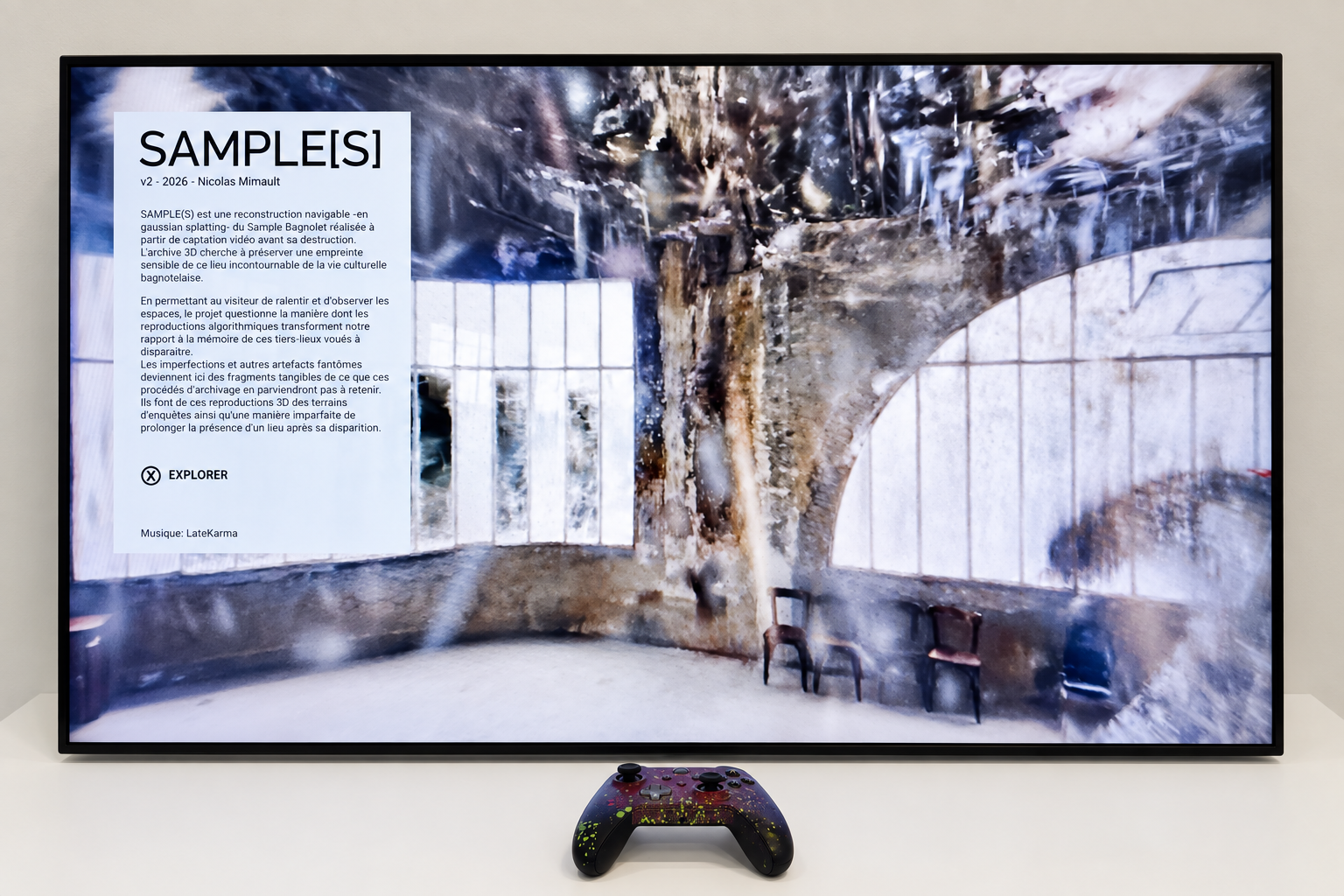
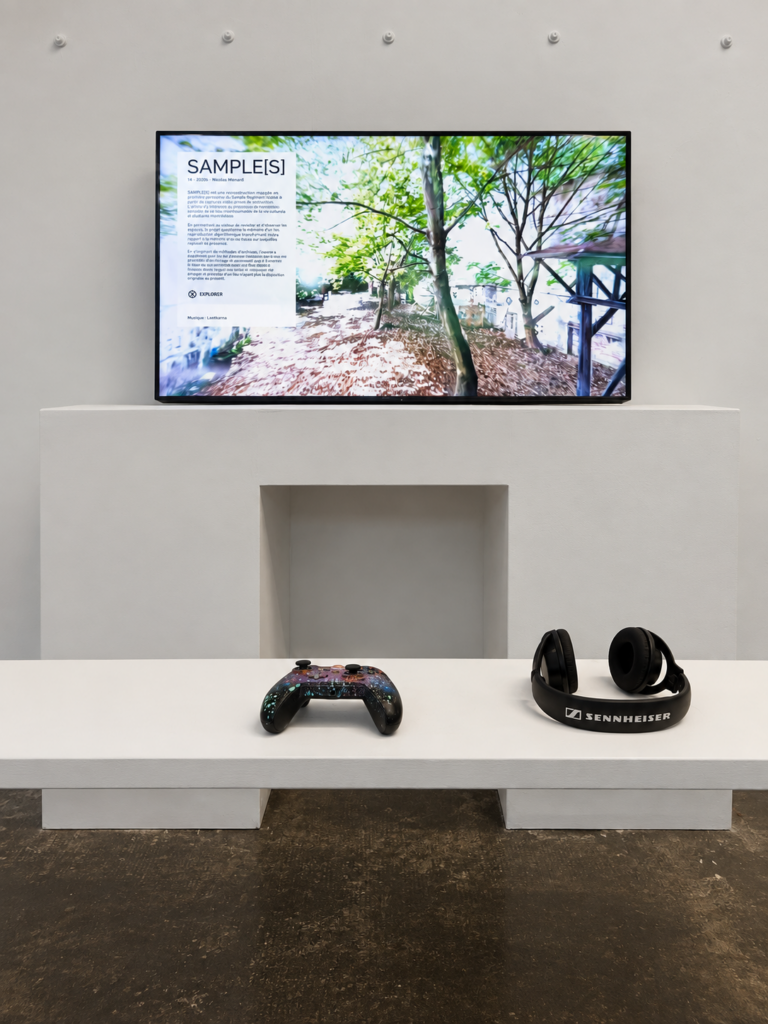
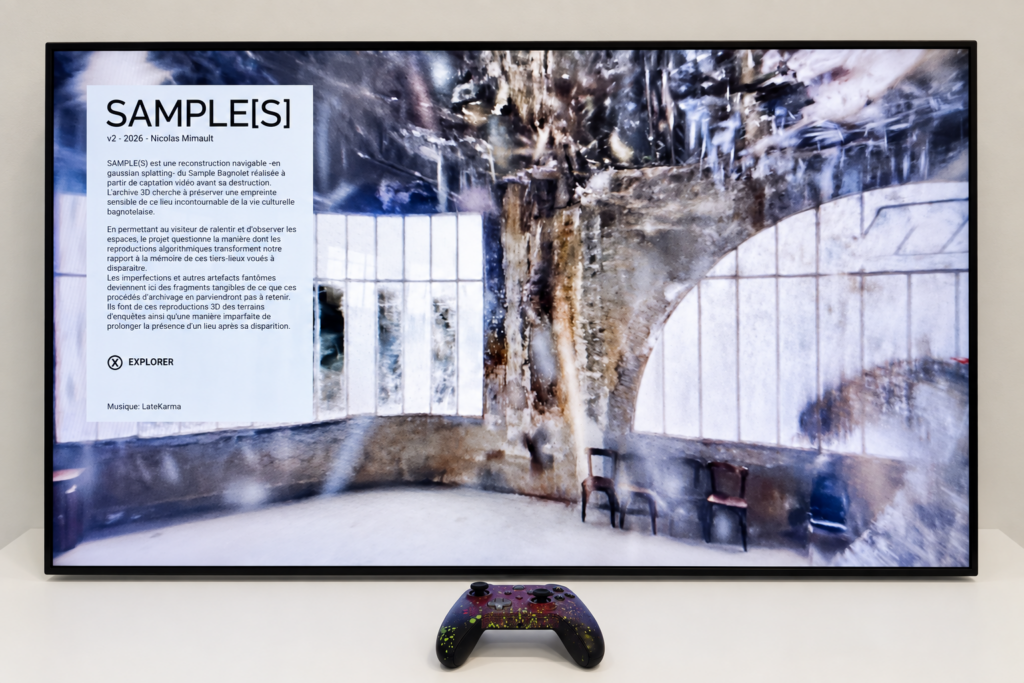
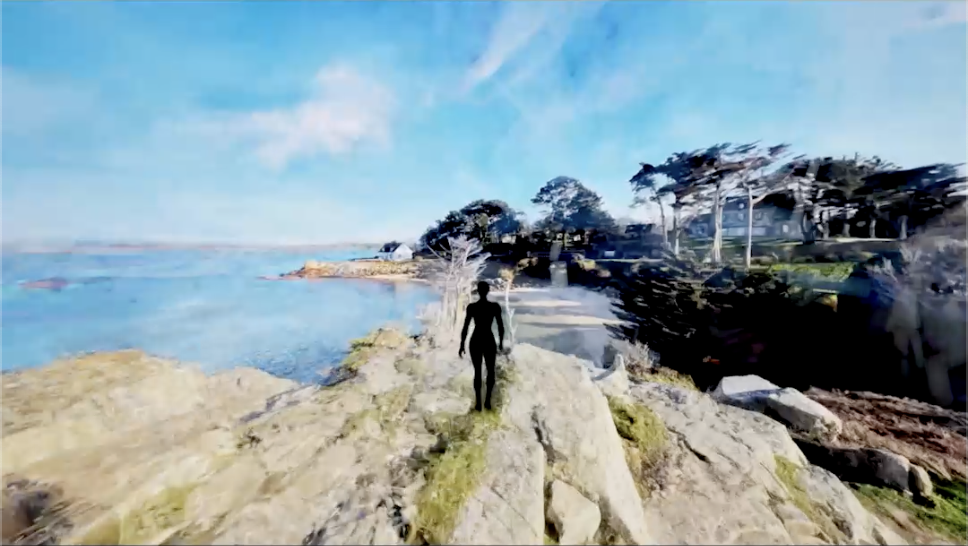
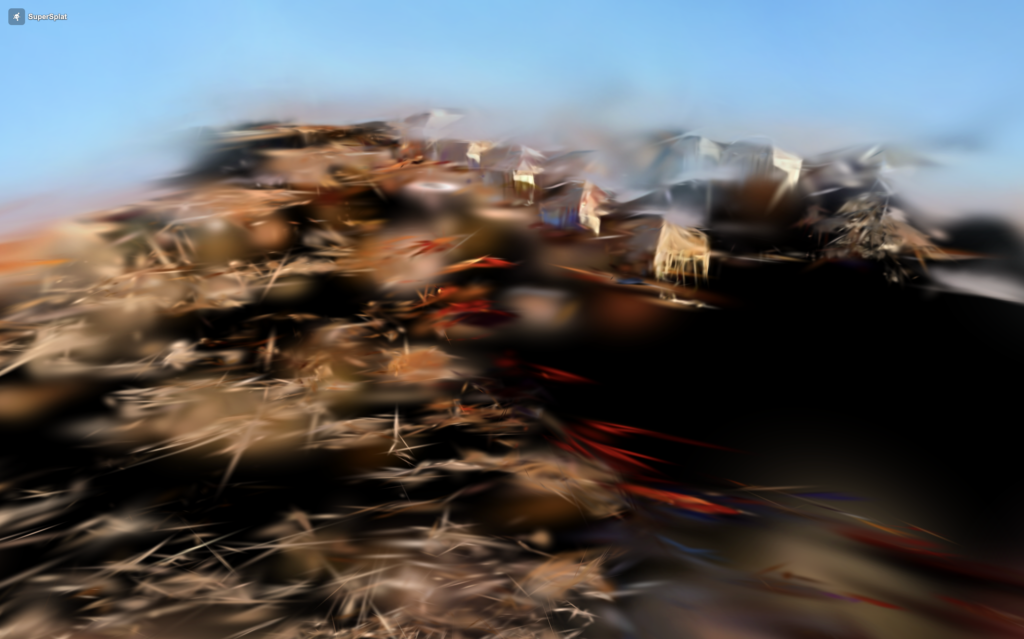
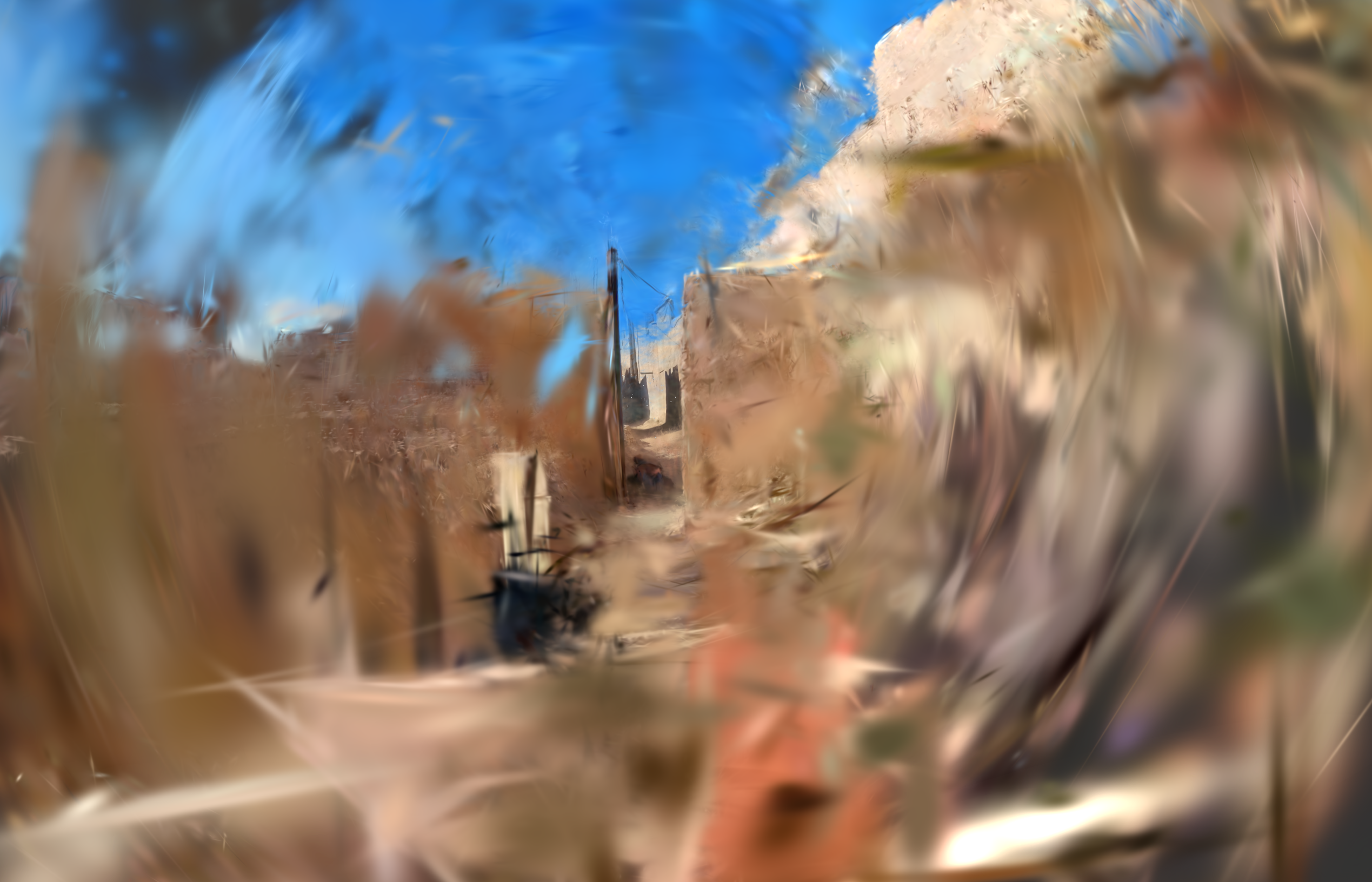
SAMPLE(S) est une archive navigable du Sample, tiers-lieu de Bagnolet, reconstituée par Gaussian Splatting avant la fermeture du lieu en juin 2026. Plus de trente espaces capturés — ateliers, tunnel, jardin, salle de concert — navigables en temps réel sous Unreal Engine.
Waiting screen
Une caméra cinématique se déplace en temps réel à travers les espaces de l’archive — travelling automatique dans les scènes GS en patchwork. C’est l’écran d’accueil du dispositif, le temps que le visiteur commence à jouer. La vidéo ci-dessous en est une capture.
SAMPLE(S) — Waiting screen — Le Sample, Bagnolet, juin 2026 — Music: LateKarma
Gameplay — 30+ scènes
Dix minutes de navigation à travers l’ensemble des espaces capturés. L’avatar traverse le lieu de l’entrée aux ateliers, du tunnel au jardin. Chaque scène est une reconstruction distincte, reliée aux autres par un système de portails.
SAMPLE(S) — Full gameplay, 30+ scenes — Le Sample, Bagnolet, juin 2026 — Music: LateKarma
SAMPLE(S) is a navigable archive of Le Sample, a cultural venue in Bagnolet, reconstructed using Gaussian Splatting before the venue closed in June 2026. 30+ spaces captured — studios, tunnel, garden, concert hall — navigable in real time inside Unreal Engine.
Waiting screen
A cinematic camera moves through the archived spaces in real time — an automatic travelling across GS scenes in patchwork. This is the device’s welcome screen, displayed while waiting for the visitor to start playing. The video below is a screen capture of this sequence.
Gameplay — 30+ scenes
Ten minutes of navigation through all captured spaces. The avatar moves through the venue from the entrance to the studios, from the tunnel to the garden. Each scene is a distinct reconstruction, connected to the others through a portal system.
Part of an ongoing research on navigable volumetric reconstructions and the limits of algorithmic capture.
Notes d’exposition — Le Sample, Bagnolet, juin 2026
→ English below
Le Sample a fermé ses portes le 20 juin. L’exposition finale des résidents a duré trois semaines, du 4 au 20 juin. SAMPLE(S) y était présenté dans sa version la plus complète à ce jour : une trentaine de scènes reconstituées par Gaussian Splatting, navigables en temps réel sous Unreal Engine. Des ateliers d’artistes, des espaces communs, la salle de concert, le jardin.
Visiteur au dispositif — Exposition SAMPLE(S), Le Sample, Bagnolet, juin 2026
Voici quelques premières observations.
Le poids de la disparition
« Où est mon atelier ? », « c’est trop précieux d’avoir ça », « oh, tu as fait cet espace aussi !? » autant de réactions qui disaient moins l’intérêt pour le dispositif que le soulagement d’avoir une trace pour les résidents du Sample.
Cette archive n’était pas seulement un objet de curiosité technique. Ce que les utilisateurs cherchaient d’abord, c’était vérifier les limites de l’archive par rapport à leur connaissance du lieu : ce qui avait été capturé ou non, ce qui était encore là retrouver une affiche, un flyer, un détail. La charge affective d’un lieu qui disparaît change complètement le rapport à sa reproduction algorithmique.
Deux publics, deux expériences
L’écart entre ceux qui connaissaient le lieu et ceux qui ne le connaissaient pas était visible dans la façon de se déplacer. Les résidents allaient directement vers leur atelier, leur coin, leur espace. Les visiteurs extérieurs faisaient de même: ils se dirigeaient d’abord vers les lieux qu’ils venaient de traverser physiquement (entrée, salle de prog, jardin, jusqu’à la salle d’exposition du dispositif), l’installation étant exposée dans les espaces qu’elle reconstituait.
Cette différence confirme une des hypothèses du projet : l’expérience de l’archive navigable diffère selon qu’on a vécu ce lieu ou non. Pour les uns, c’est une résurgence mémorielle. Pour les autres, une découverte potentielle d’un espace. Il a été intéressant de noter que certains visiteurs ont d’abord découvert le lieu par sa transformation algorithmique et ont été décontenancés par cette impression de déjà-vu pendant la visite du lieu réel.
Enfants au dispositif — Exposition SAMPLE(S), Le Sample, Bagnolet, juin 2026
La manette et la navigation spatiale comme barrière
Un point que je n’avais pas suffisamment anticipé : la manette de jeu représente une barrière réelle à l’entrée. Ceux qui n’ont pas l’habitude des jeux vidéo peinent à se déplacer, regardent leurs mains plutôt que l’écran, abandonnent rapidement, par frustration ou par honte. « Je ne vais pas réussir », « je ne joue pas aux jeux vidéo », « ne me jugez pas ».
Les enfants, eux, même si la navigation est parfois difficile et qu’il n’y a pas de gamification, s’en emparent immédiatement.
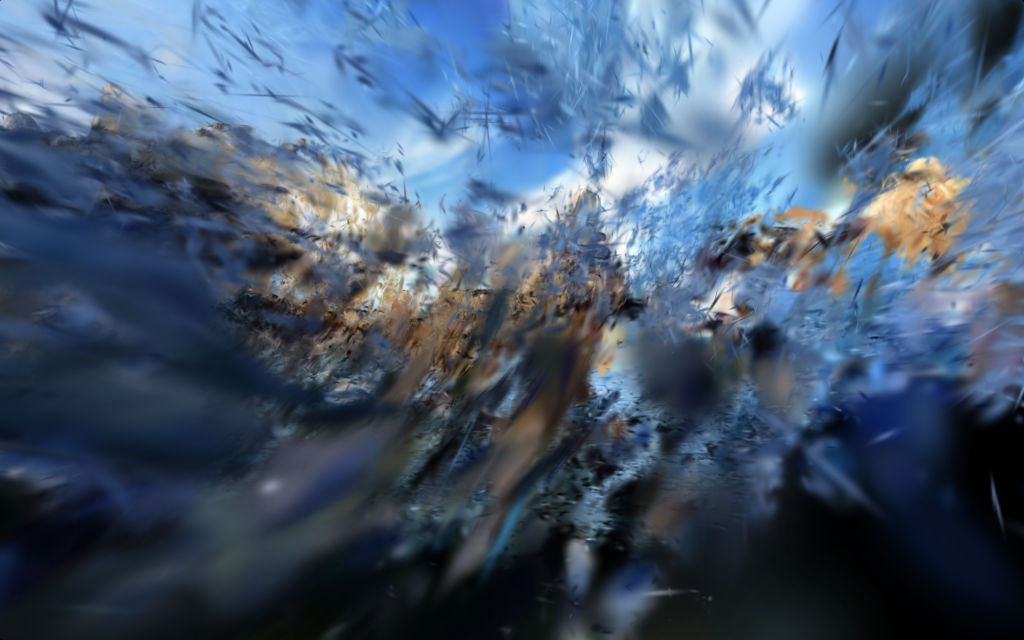
Les « erreurs » de trajectoire et de contrôle de la caméra créent des vues improbables, personnage qui navigue en contre-plongée totale, angles impossibles. Une forme de déambulation involontaire qui produit ses propres révélations.
Si la déambulation et l’observation sont le principe de connaissance central du projet, qu’est-ce qu’on perd quand ce geste est bloqué par l’outil qui le permet ?
Visiteurs au dispositif — Exposition SAMPLE(S), Le Sample, Bagnolet, juin 2026
Ce que les gens cherchent
Les visiteurs, résidents ou non, cherchent d’abord à parcourir les espaces plus qu’à les observer. Ils veulent aller quelque part, comprendre la déambulation possible dans l’archive. Mais ce qui les interpelle ensuite, ce sont les imperfections (les glitchs, les zones floues, les déformations ) qui font apparaître la technique elle-même. « C’est dommage qu’on ne puisse pas prendre plus de recul par rapport à l’objet. » L’archive navigable appelle une forme de mobilité qui va de pair avec des questionnements techniques.
Ce que ça ouvre
Ce que révèle la déambulation dans une empreinte algorithmique, c’est d’abord la relation affective au lieu, avant même que commence l’enquête sur ce que l’algorithme en a retenu ou effacé.
La prochaine étape est d’appliquer cette approche de navigation 3D dans des reproductions algorithmiques à un terrain que je ne connais pas : en septembre, je rejoins le musée national estonien pour travailler avec leurs archives photographiques. Un lieu que je n’ai jamais habité, une collection que je ne connais pas. Ce sera l’occasion d’explorer ce que la transformation algorithmique d’une photographie en espace navigable révèle quand on n’a pas de souvenirs de ce lieu — qui a peut-être déjà disparu.
EN
Exhibition notes — Le Sample, Bagnolet, June 2026
Le Sample closed on June 20th. The final residents’ exhibition ran for three weeks, from June 4th to 20th. SAMPLE(S) was presented in its most complete version to date: around thirty scenes reconstructed using Gaussian Splatting, navigable in real time under Unreal Engine. Artists’ studios, shared spaces, the concert hall, the garden.
Here are some initial observations.
The weight of disappearance
“Where is my studio?”, “it’s so precious to have this”, “oh, you did this space too!?” — reactions that spoke less to interest in the device than to the relief of having a trace.
This archive was not merely an object of technical curiosity. What users looked for first was to verify the limits of the archive against their own knowledge of the place: what had been captured or not, what was still there — finding a poster, a flyer, a detail. The affective weight of a disappearing place completely changes one’s relationship to its algorithmic reproduction.
Two publics, two experiences
The gap between those who knew the place and those who didn’t was visible in the way they moved. Residents went straight to their studio, their corner, their space. Outside visitors did the same — they first headed toward spaces they had just physically passed through, the installation being exhibited within the very spaces it reconstructed.
This confirms one of the project’s hypotheses: the experience of the navigable archive differs depending on whether one has lived in the place or not. For some, it is a memorial resurgence. For others, a potential discovery of an unknown space. Notably, some visitors first encountered the place through its algorithmic transformation, and felt a strange sense of déjà-vu when visiting the real space afterward.
The controller as barrier
Something I hadn’t sufficiently anticipated: the game controller represents a real barrier to entry. Those unfamiliar with video games struggle to move through the space, look at their hands rather than the screen, and give up quickly — out of frustration or embarrassment. “I’m not going to manage”, “I don’t play video games”, “don’t judge me”.
Children, on the other hand, immediately take hold of it — even without gamification, even when navigation is difficult. Their “errors” in trajectory and camera control produce improbable views: characters navigating in full counter-angle, impossible perspectives. A form of involuntary wandering that generates its own revelations.
If wandering and observation are the central knowledge-producing gestures of the project, what do we lose when those gestures are blocked by the tool that enables them?
What people are looking for
Visitors — residents or not — first seek to move through spaces rather than observe them. They want to go somewhere. But what catches their attention next are the imperfections: the glitches, the blurred zones, the distortions that make the technique itself visible. “It’s a shame you can’t step back further from the object.” The navigable archive calls for a form of mobility that goes hand in hand with technical questioning.
What this opens
What wandering through an algorithmic imprint reveals is, first of all, an affective relationship to a place — before the inquiry into what the algorithm retained or erased even begins.
The next step is to apply this approach to a terrain I don’t know: in September, I join the Estonian National Museum to work with their photographic archives. A place I have never inhabited, a collection I don’t know. An opportunity to explore what the algorithmic transformation of a photograph into a navigable space reveals when one has no memory of the place — which may have already disappeared.
Part of an ongoing research on navigable volumetric reconstructions and the limits of algorithmic capture.
Field notes — Port-Blanc, Penvénan, Côtes-d’Armor, Bretagne
→ English below
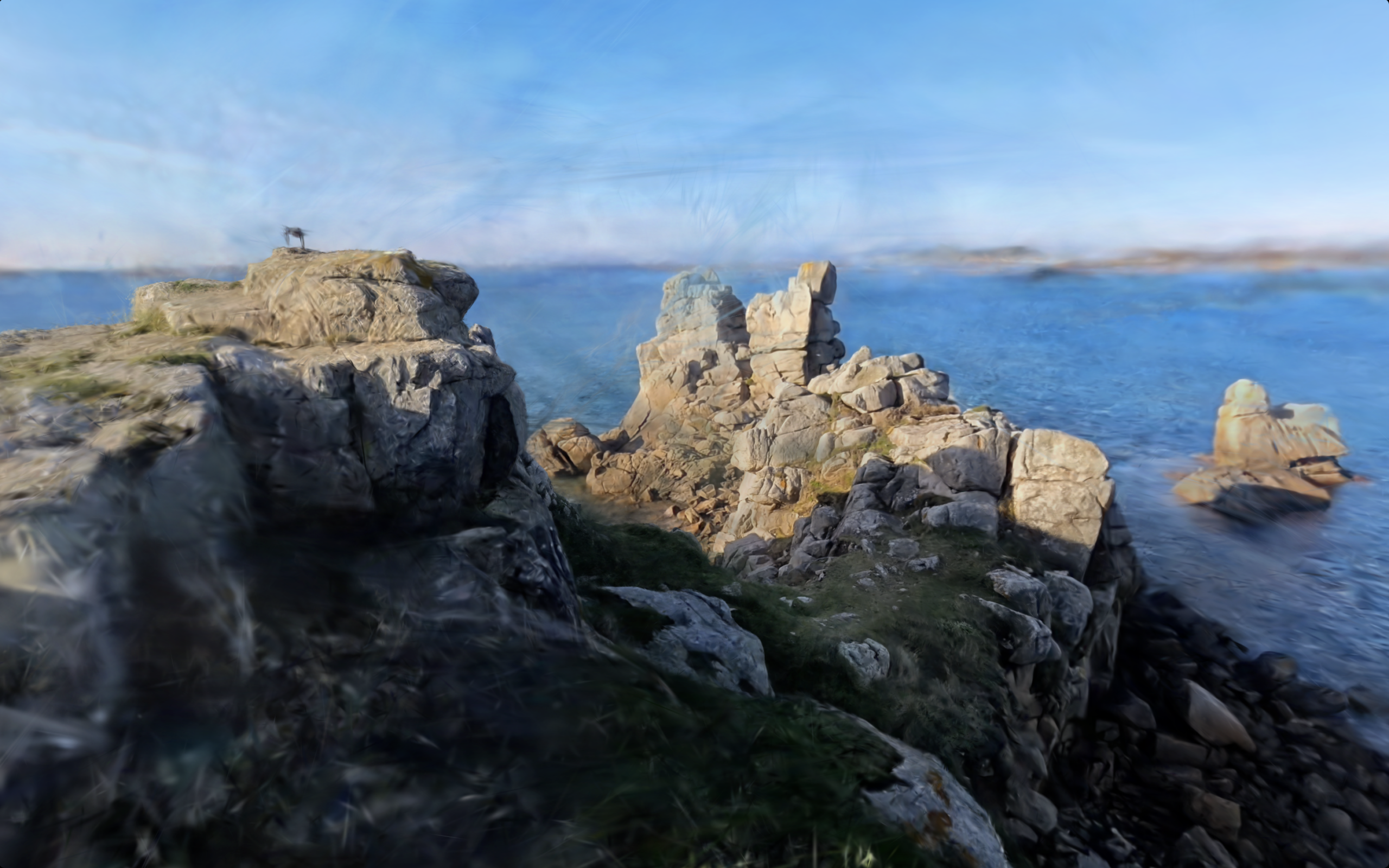
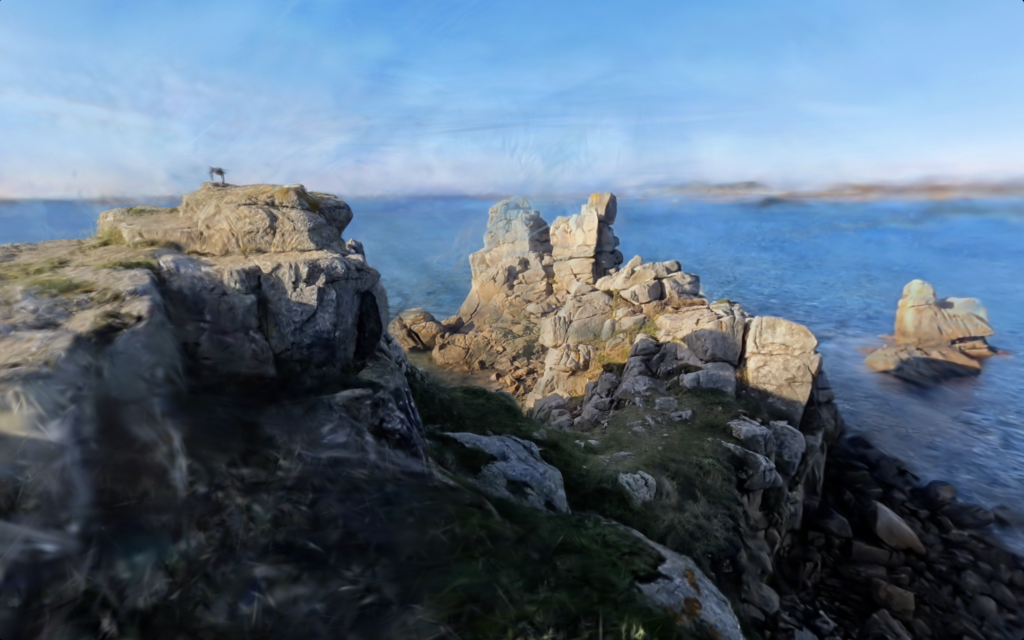
Port-Blanc, Penvénan, le Rocher du Voleur. Sentier côtier sur la falaise, reconstruit par Gaussian Splatting.
Seuls les éléments proches de la trajectoire de capture sont restitués avec précision : la roche, le chemin, l’herbe rase.
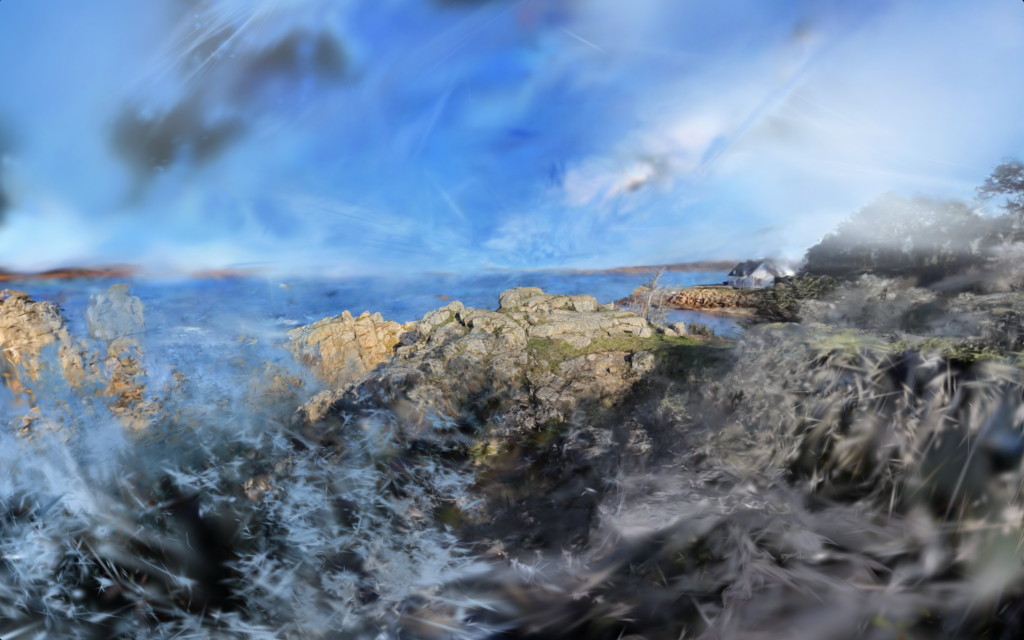
L’horizon reste flou et instable, totalement dépendant du point de vue du spectateur dans la scène entre ciel, terre et mer.
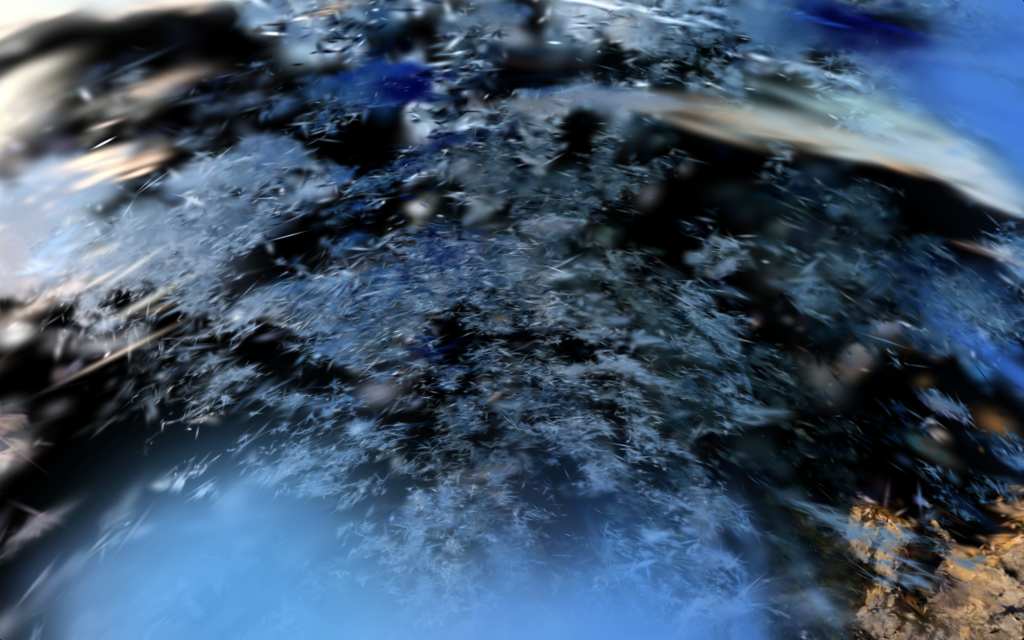
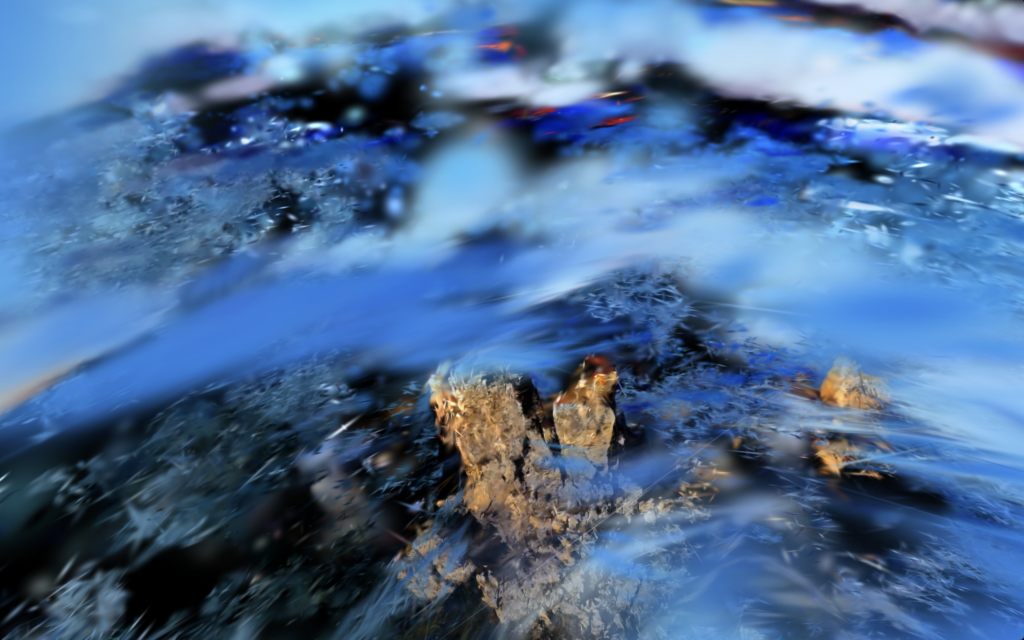
La mer ne peut pas être capturée — constamment en mouvement, elle échappe à l’algorithme qui a besoin de surfaces stables. Elle se dissout dans un ensemble uniforme de splats flous de loin, qui éclate en particules abstraites de près. En dirigeant le regard vers l’eau, la mer devient un champ de particules qui composent une surface que l’algorithme n’a jamais vraiment vue.
En changeant la hauteur du point de vue dans la scène, on voit apparaître plusieurs nappes de splats à différentes altitudes. L’algorithme a créé ces layers pour satisfaire différents points de vue du dataset — traces de cette logique de reconstruction par vues.
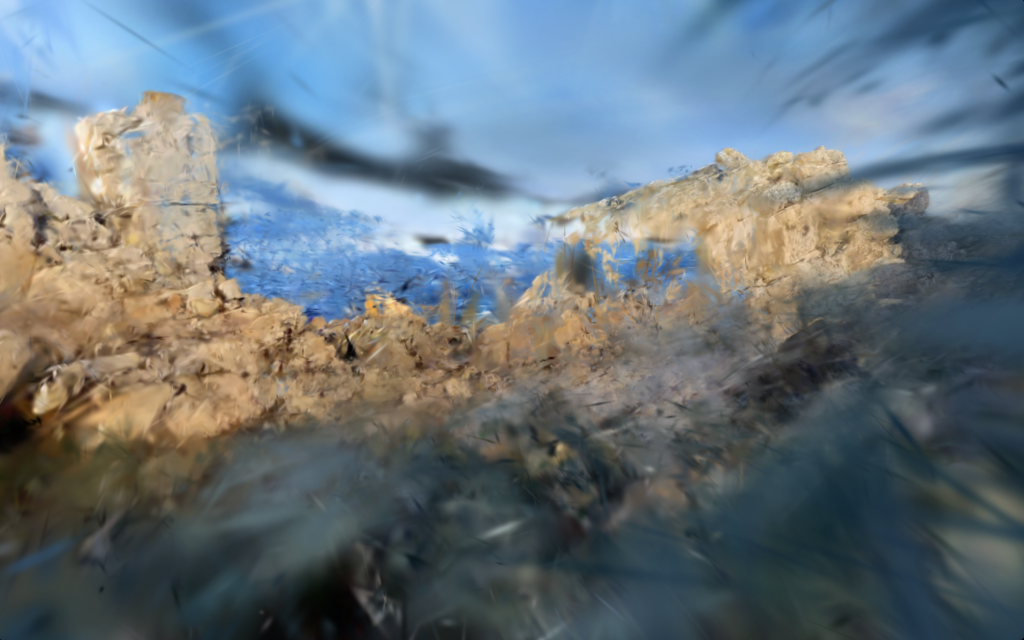
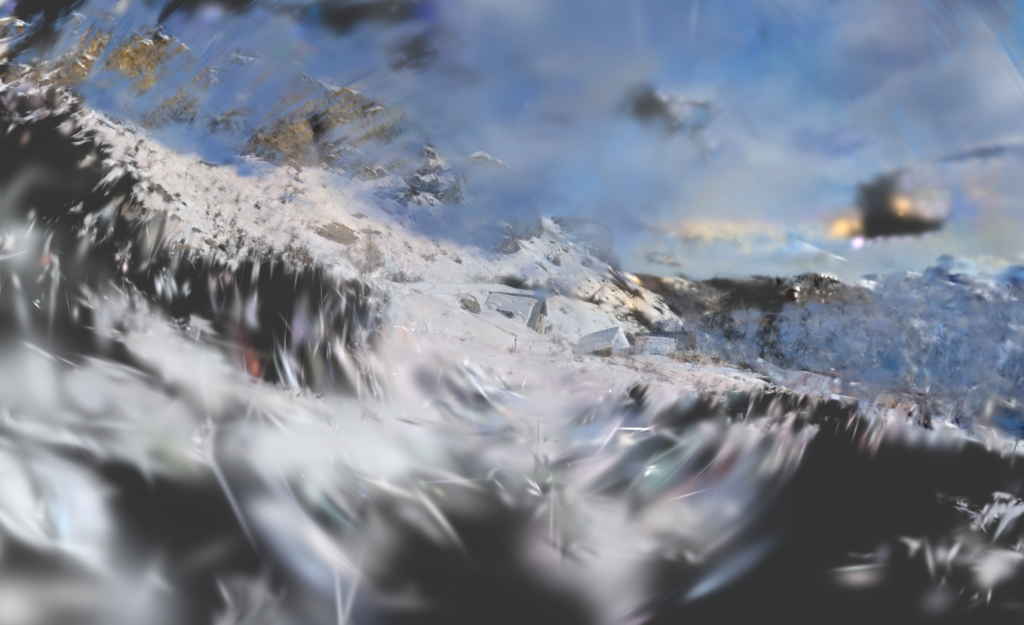
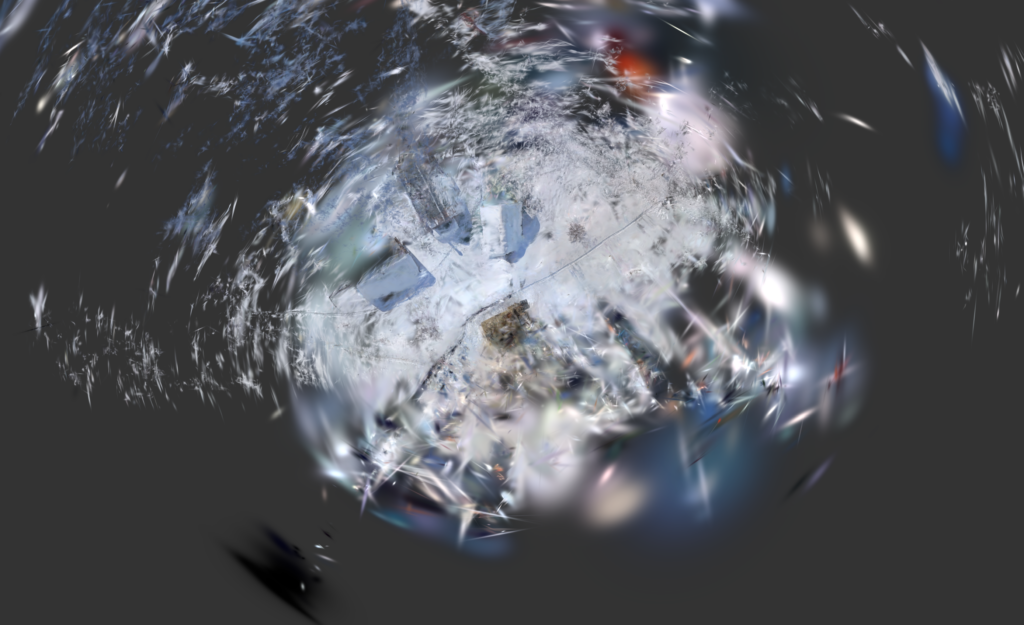
Les images à la limite du radiance field révèlent la structure de la reconstruction : captures de vues en plongée, contre-plongée, depuis les bords de la zone capturée.
Il est possible d’avoir une vue “depuis sous l’eau” sans jamais y être entré.
Se balader dans la reconstruction révèle ses limites.
Port-Blanc, Penvénan — the Rocher du Voleur. Coastal cliff path, reconstructed with Gaussian Splatting.
Only elements close to the capture path are rendered with precision: rock, path, sparse grass.
The horizon remains blurred and unstable, entirely dependent on the viewer’s point of view within the scene — between sky, land and sea.
The sea cannot be captured — constantly in motion, it escapes the algorithm that needs stable surfaces. From a distance it dissolves into a uniform field of blurred splats; up close it bursts into abstract particles. Directing the gaze toward the water, the sea becomes a field of particles composing a surface the algorithm never truly saw.
Changing the height of the viewpoint in the scene reveals several layers of splats at different altitudes. The algorithm created these layers to satisfy different points of view from the dataset — traces of this view-based reconstruction logic.
Images at the edge of the radiance field reveal the structure of the reconstruction: overhead views, low angles, from the margins of the captured zone.
It is possible to have a view “from underwater” without ever entering it.
Walking through the reconstruction reveals its limits.
1 — Interactive scene
Gaussian Splatting — navigable scene (SuperSplat viewer)
2 — Traveling through the reconstructed scene
Coastal cliff traveling — Unreal Engine, particle forces via TouchDesigner
Player: Unreal Engine Particle forces: TouchDesigner — MIDI to OSC
Processing
Post-clean: none
3 — Gaussian Splatting training
Gaussian Splatting training — 1.6M splats (PostShot)
4 — Raw 360° capture
Source footage — Insta360 X4, equirectangular projection, 4:47 min
5 — Scene captures
Scene capture — coastal rocks, Rocher du VoleurRadiance field frontier — lateral viewGaze toward the sea — surface as splat materialRadiance field — top view, abstract captureAbstract capture — lateral viewAbstract capture — from “underwater”, out of field
Part of an ongoing research on navigable volumetric reconstructions and the limits of algorithmic capture.
Field notes — Port-Blanc, Penvénan, Côtes-d’Armor, Bretagne
→ English below
Enfin le printemps. Le sentier côtier au-dessus de Port-Blanc, reconstruit en scène 3D navigable par Gaussian Splatting, rendu en temps réel dans un moteur de jeu.
L’avatar est en haut de la falaise — il peut regarder la côte, la mer vers l’horizon, se balader parmi les rochers et la végétation printanière. Un espace ouvert, entre terre et mer.
L’avatar a un corps dans l’espace reconstruit : une échelle, une présence physique dans un lieu qui n’existe plus vraiment. Mais il n’a pas d’ombre. Corps stable, purement virtuel, face à une capture de la réalité instable et fragmentée. L’avatar donne une échelle et une présence — il ancre le visiteur dans l’espace, rend l’immersion possible.
Les forces de particules répondent au passage de l’avatar — l’espace réagit au visiteur. Les splats se dispersent, révèlent leur nature de pixels de l’espace : la matière brute de l’archive.
On peut s’écarter du sentier, explorer la falaise, voir l’intérieur des rochers — des espaces que la caméra a longés mais jamais traversés.
Pour que l’avatar puisse se déplacer sur le terrain, j’ai dû ajouter des plateformes invisibles. Le sol de la reconstruction n’est pas un sol : c’est une image. Il a fallu construire une géographie praticable par-dessus la géographie capturée.
Le dispositif permet de passer de la troisième à la première personne. En troisième personne, l’avatar nous projette comme sujet dans l’espace — on est dans le lieu. En première personne, le regard devient plus immersif : on peut s’arrêter sur un détail, s’approcher d’une surface, observer ce que la troisième personne survole.
Est-ce qu’on se promène dans un souvenir ? Que se passe-t-il quand un corps stable traverse un espace instable ?
Finally spring. The coastal path above Port-Blanc, reconstructed into a navigable 3D scene using Gaussian Splatting, rendered in real time in a game engine.
The avatar stands at the top of the cliff — it can look along the coastline, toward the sea and the horizon, and wander among the rocks and spring vegetation. An open space, between land and sea.
The avatar has a body in the reconstructed space: a scale, a physical presence in a place that no longer truly exists. But it casts no shadow. A stable body, purely virtual, facing an unstable and fragmented capture of reality. The avatar provides scale and presence — it anchors the visitor in the space, makes immersion possible.
Particle forces respond to the avatar’s passage — the space reacts to the visitor. Splats scatter, revealing their nature as space pixels: the raw material of the archive.
It is possible to leave the path, explore the cliff, see inside the rocks — spaces the camera walked alongside but never entered.
For the avatar to move across the terrain, I had to add invisible platforms. The floor of the reconstruction is not a floor: it is an image. A walkable geography had to be built on top of the captured geography.
The device allows switching between third and first person. In third person, the avatar projects us as subject into the space — we are in the place. In first person, the gaze becomes more immersive: one can pause on a detail, approach a surface, notice what the third-person view passes over.
Are we walking through a memory? What happens when a stable body moves through an unstable space?
1 — Traveling through the reconstructed scene
Coastal path reconstruction — Unreal Engine, particle forces via TouchDesigner
Interaction
Player interaction: Unreal Engine Particle system forces: TouchDesigner — MIDI to OSC
Field notes — Orcières Merlette, Hautes-Alpes, French Alps
→ English below
Deux façons d’habiter le même espace reconstruit. Passer de la troisième à la première personne dans une reproduction Gaussian Splatting.
En troisième personne, l’avatar habite l’espace : on le parcourt, on en perçoit la structure globale et le rapport aux échelles du corps de l’entité qui traverse la scène. En première personne, le visiteur l’habite et l’observe : on peut s’arrêter, s’approcher d’un détail, remarquer ce qui échappe au regard lors de la captation de l’espace réel. C’est une posture différente face à l’archive: une autre modalité d’attention. Incarner le point de vue permet de cultiver un art de remarquer ce qui persiste, ce qui s’agence, ce qui résiste à la reconstruction.
Cette évolution du dispositif questionne ce que change le fait d’observer un espace volumétrique à la première personne : comment la navigation transforme-t-elle notre rapport à la mémoire d’un lieu parcouru ?
EN
Two ways of inhabiting the same reconstructed space. Switching between third-person and first-person inside a Gaussian Splatting reproduction.
In third person, the avatar inhabits the space: one moves through it, perceiving its global structure and the scalar relationship to the body of the entity traversing the scene. In first person, the visitor inhabits and observes it: pausing, approaching a detail, noticing what escapes the gaze during the capture of the real space. This is a different posture toward the archive: another modality of attention. Embodying the viewpoint allows cultivating an art of noticing what persists, what assembles, what resists reconstruction.
This evolution of the protocol questions what changes when observing a volumetric space in first person: how does navigation transform our relationship to the memory of a visited place?
1 — First & third person navigation
First & third person navigation — Unreal Engine, XV3DGS plugin Music: Amon Tobin — Yasawas
Interaction
Player interaction: Unreal Engine — XV3DGS plugin Particle system forces configurable via TouchDesigner — MIDI to OSC
Field notes — Orcières Merlette, Hautes-Alpes, French Alps
→ English below
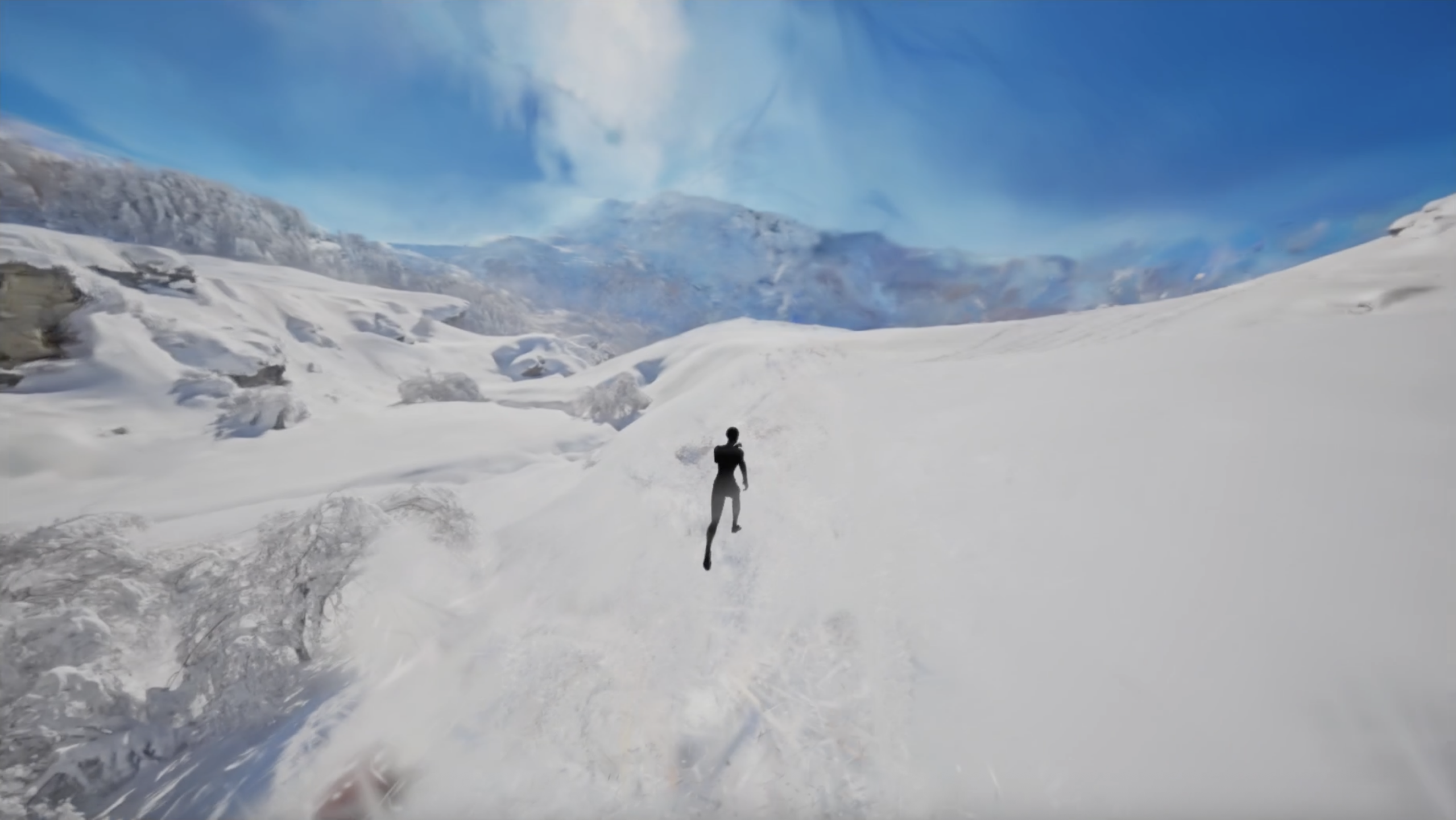
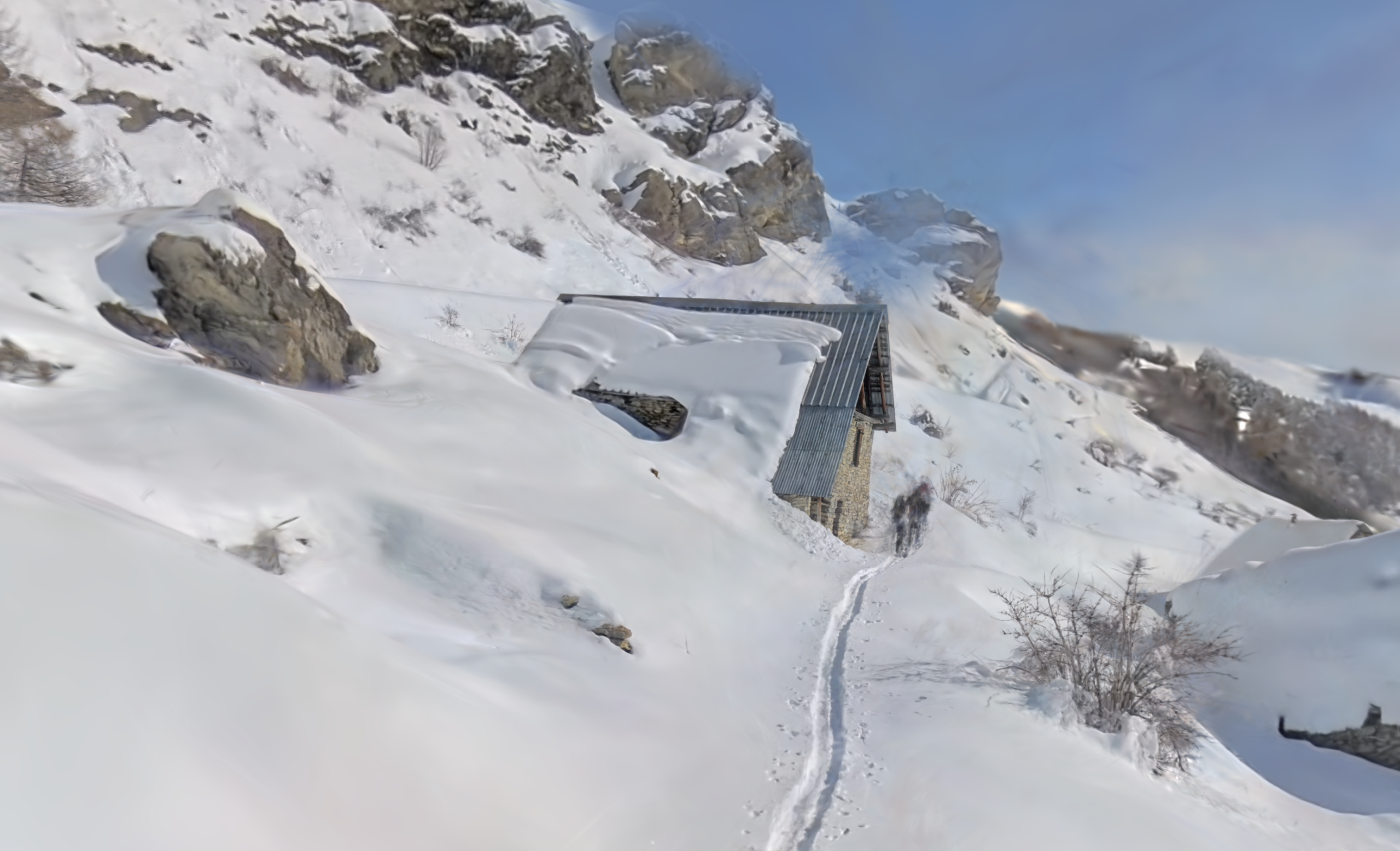
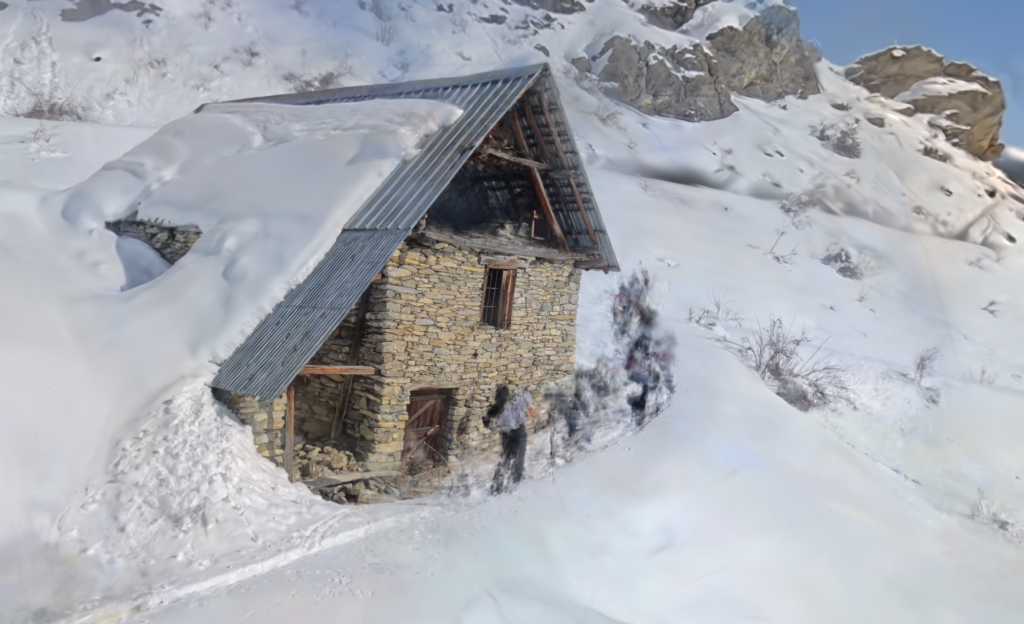
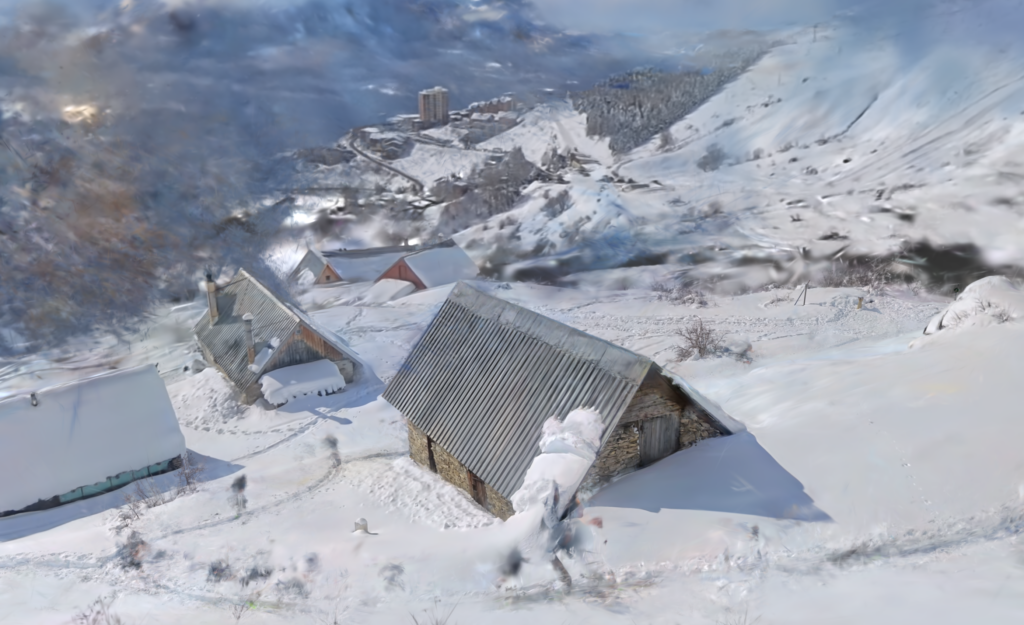
Les skieurs qui avancent sur la piste créent des artefacts qui révèlent les limites de ce que l’algorithme peut reconstruire à partir d’éléments en mouvement dans le dataset. Capture réalisée à ski, caméra sur perche balancée de gauche à droite, un geste pour élargir le point de vue. Ce mouvement pendulaire introduit une variation latérale dans le dataset, mais aussi une instabilité propre au dispositif : flou de mouvement, changements d’angle rapides, reconstruction partielle des alentours.
Ghost-like traces in the reconstructed scene. Skiers moving ahead on the trail create artifacts that reveal the limits of what the algorithm can reconstruct from moving elements in the dataset. Single-path capture on skis, camera swung left to right on a pole, a gesture to broaden the viewpoint. This pendular motion introduces lateral variation into the dataset, but also instability inherent to the device: motion blur, rapid angle changes, partial reconstruction of the surroundings.
1 — Interactive 3D viewer
Gaussian Splatting — navigable scene (SuperSplat viewer)
2 — Training timelapse
Gaussian Splatting training — 48k iterations (PostShot, × 20 timelapse)
3 — Traveling through the reconstructed scene
Traveling through the reconstructed environment — Unreal Engine, XV3DGS plugin
Ghost artifacts — skiers ahead on the trail | viewpoint-dependent reconstructionDistant valley — reconstruction instability | out of focusRadiance field frontier — lateral viewRadiance field — top view, abstract capture
Part of an ongoing research on reconstruction instabilities and viewpoint-dependent artifacts in Gaussian Splatting.
Field notes — Orcières Merlette, Hautes-Alpes, French Alps
→ English below
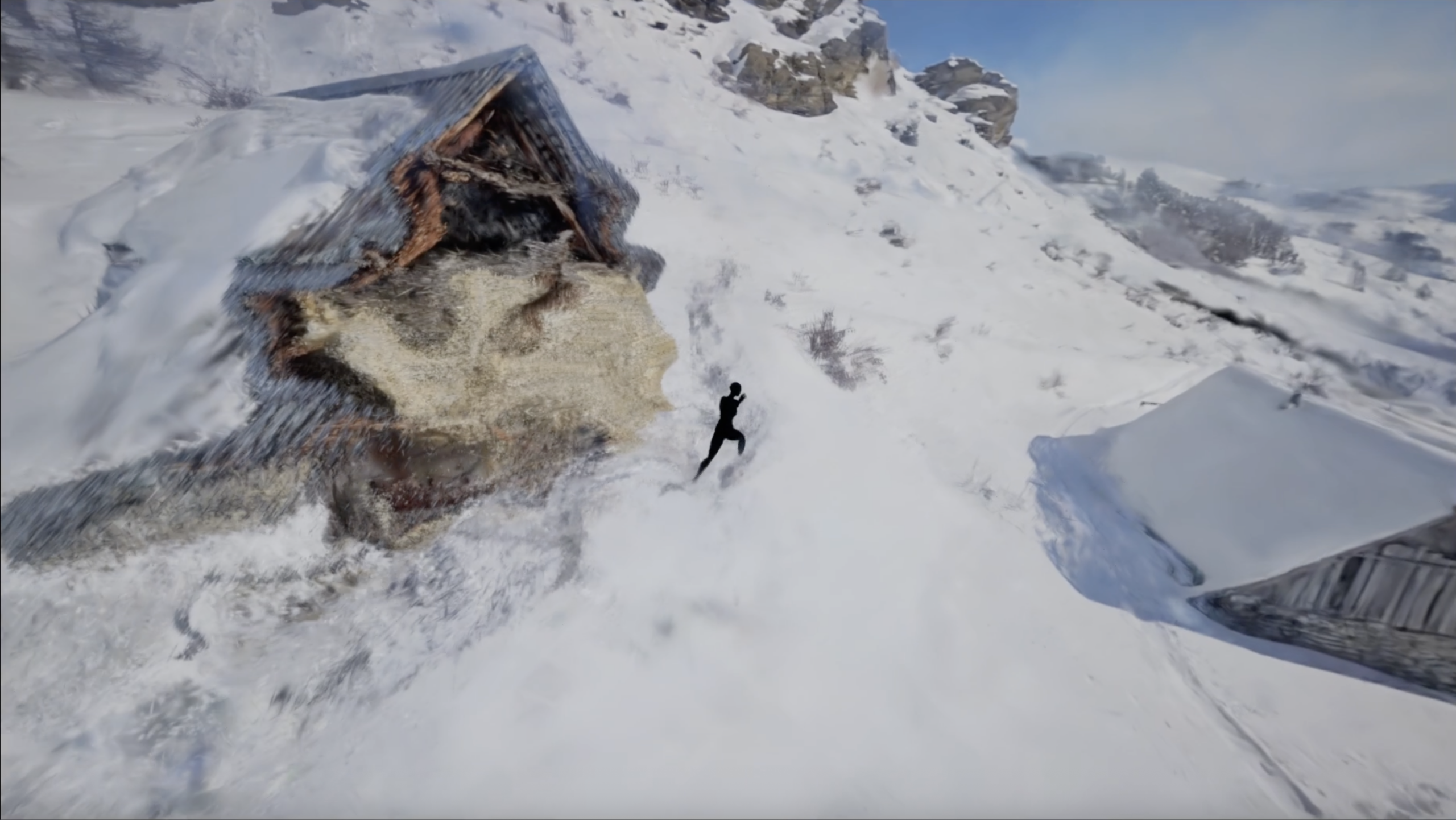
En se déplaçant dans la scène, l’avatar fait apparaître la structure même de l’archive : les splats se dispersent à son passage, révélant la nature instable et construite de la reconstruction volumétrique, proche d’un souvenir qu’on peine à saisir. Capture réalisée à ski dans un paysage de montagne ouvert, caméra sur perche balancée de gauche à droite — la reconstruction ne capte que ce qu’un seul passage avec la camera 360 en mouvement peut voir.
—
As the avatar moves through the scene, it reveals the very structure of the archive: splats scatter at its passage, exposing the unstable and constructed nature of volumetric reconstruction, like a memory we struggle to hold onto. Skiing through an open mountain landscape, camera swung left to right on a pole, the reconstruction captures only what a single moving path can see with a 360 camera.
Field notes — M’Hamid El Ghizlane, Morocco — Gateway to the Sahara
→ English below
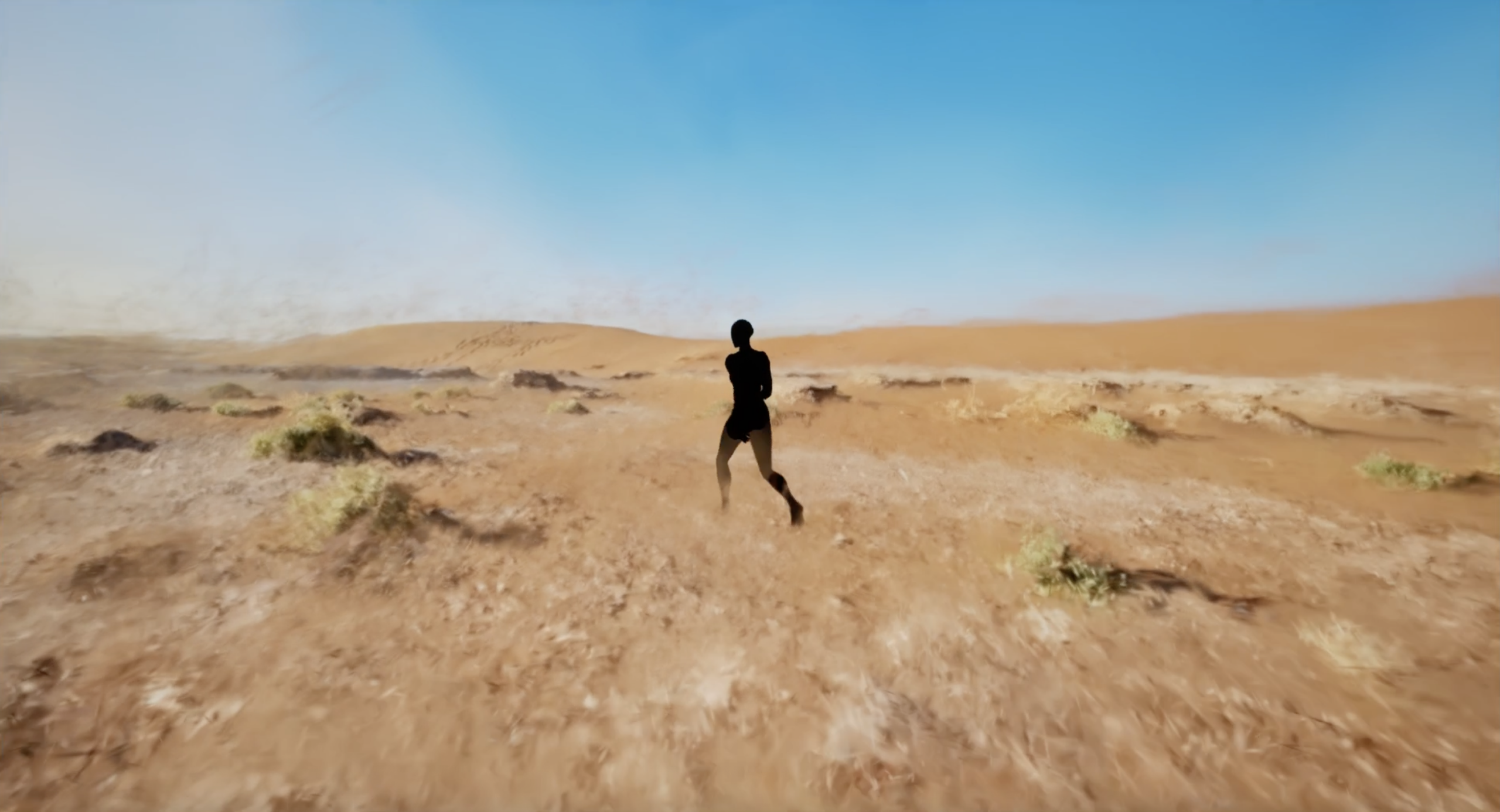
Un lieu réel reconstruit avec des particules par Gaussian Splatting. Courir déstabilise le paysage, marcher lui permet de se recomposer. Une expérience interactive pour réfléchir à notre rapport aux environnements — nos gestes transforment les espaces que nous habitons.
—
A real place reconstructed with particles using Gaussian Splatting. Running destabilizes the landscape, while walking allows it to recombine. A small interactive experiment to reflect on our relationship with environments — our gestures transform the spaces we inhabit.
Gaussian Splatting — navigable scene (SuperSplat viewer)
→ English below
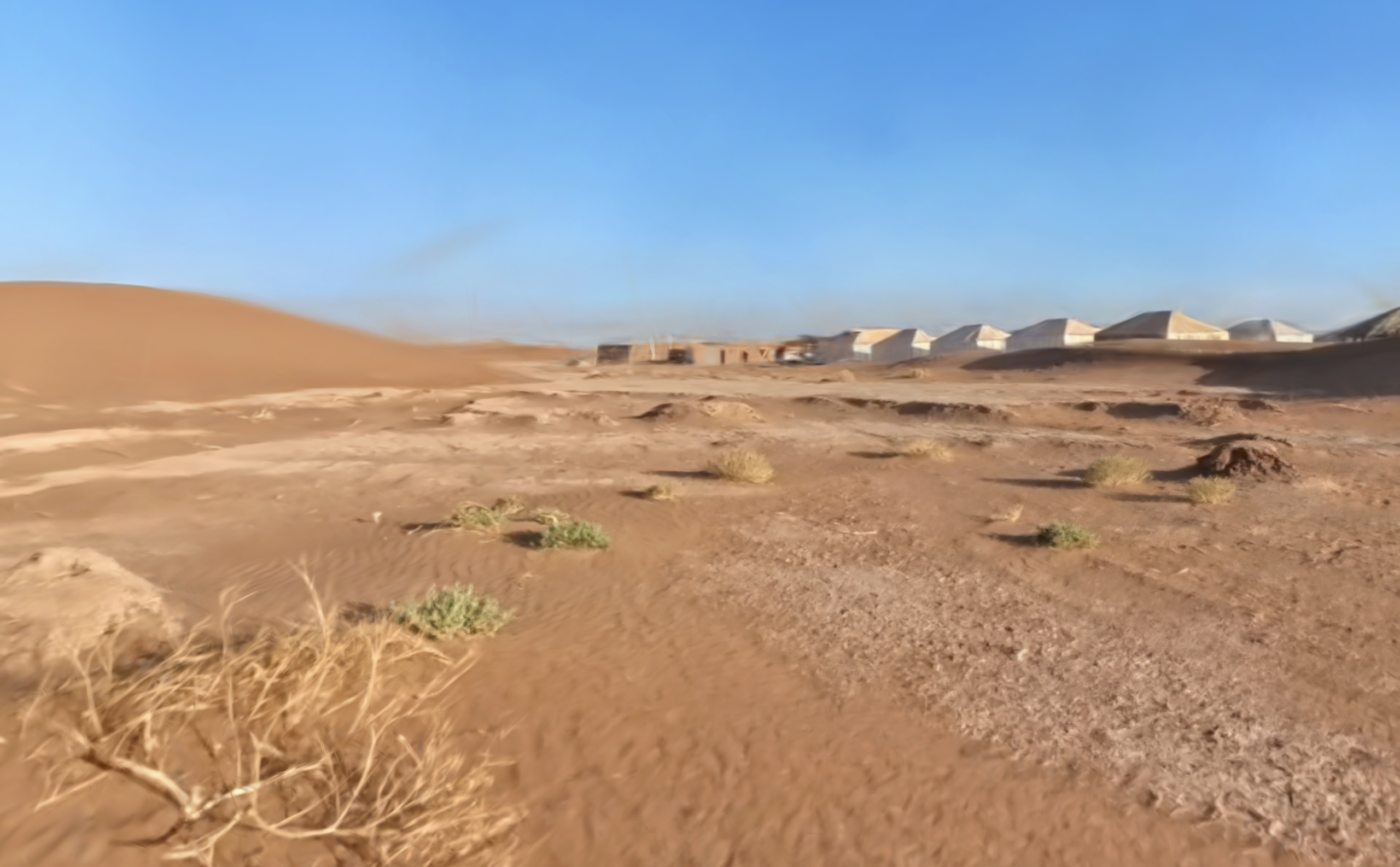
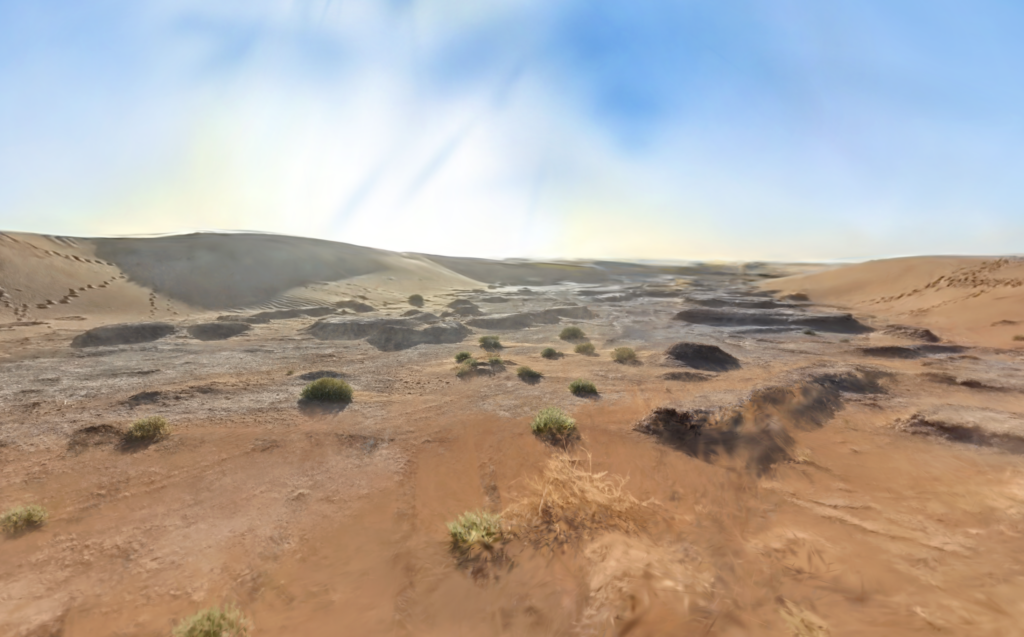
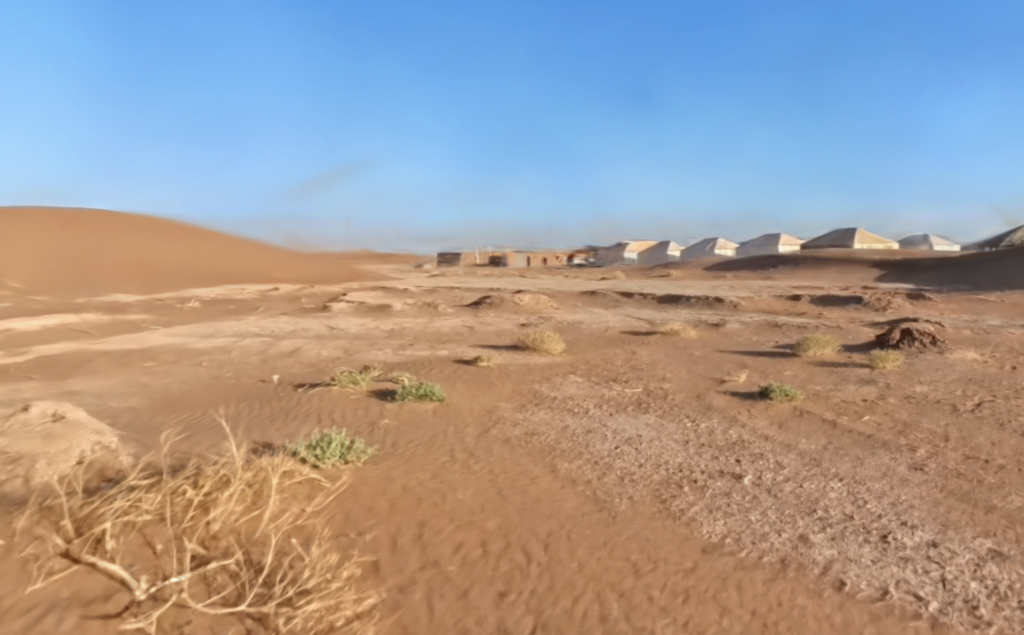
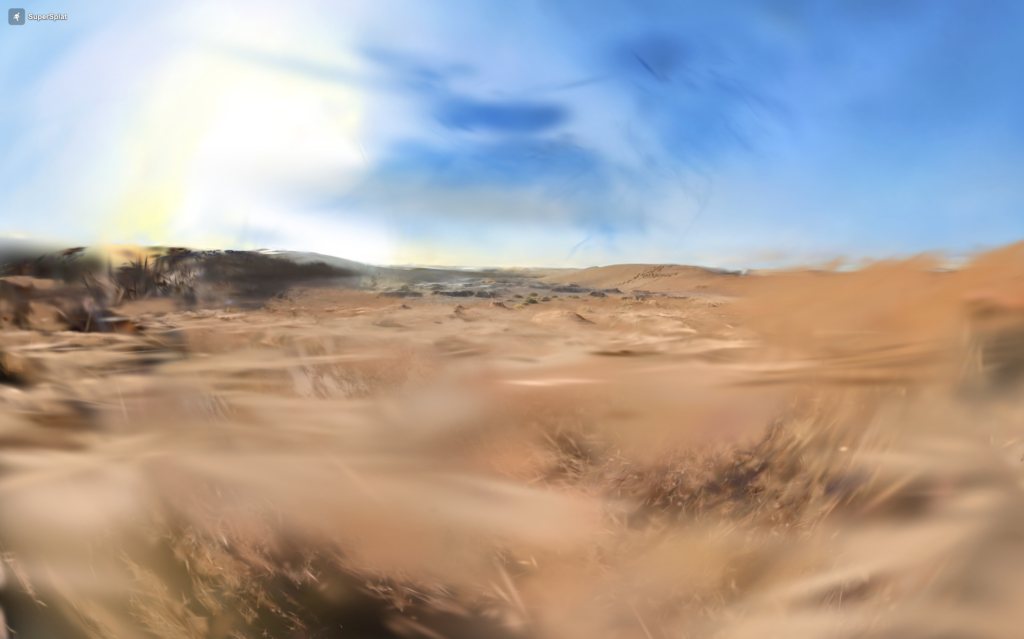
Végétation éparse, relief aride et dunes environnantes sur de longues distances. La reconstruction peine à restituer la profondeur : les dunes restent floues, l’horizon est difficile à saisir pour l’algorithme.
Capture réalisée tôt le matin, soleil très bas. La lumière rasante est forte.
Des splats beige en suspension à 2-3m apparaissent dans la scène: poussière sur la lentille ou surexposition au soleil du désert à confirmer avec l’analyse du dataset.
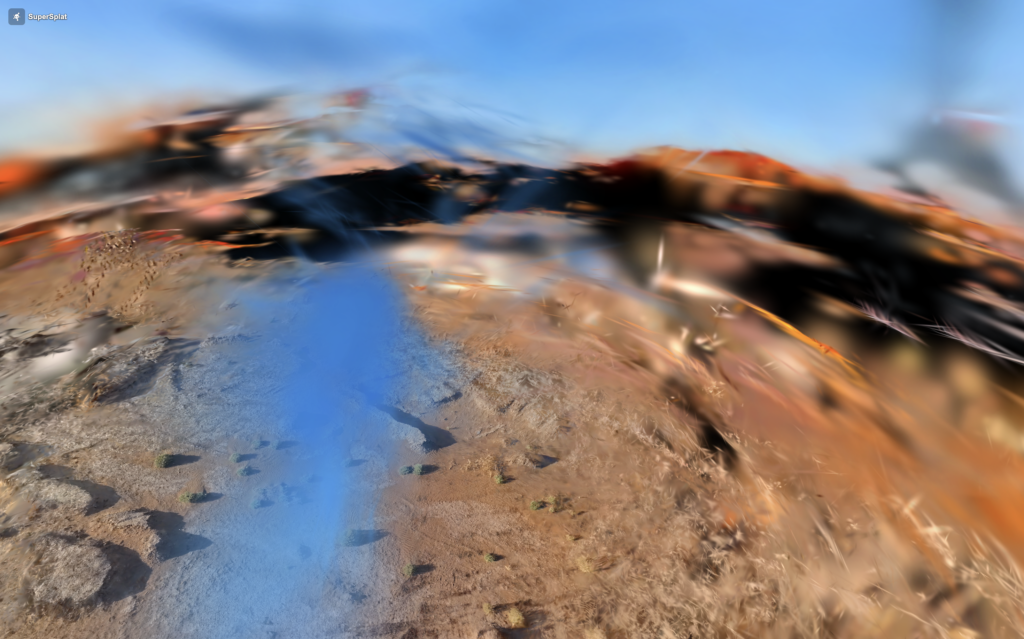
La caméra était montée sur perche à 2m50-3m de hauteur. En dessous du sol, un réseau dense de splats se déploie pour tenter de restituer les reliefs sur le sable : l’algorithme construit une profondeur qui n’existe pas dans notre vécu.
EN
Sparse vegetation, arid relief and surrounding dunes over long distances. The reconstruction struggles to render depth , dunes remain blurred, the horizon difficult for the algorithm to resolve.
Captured early in the morning, sun very low, harsh raking light.
Beige splats suspended at 2-3m appear in the scene , dust on the lens, or overexposure from the desert sun. Camera mounted on a pole at 2.5-3m height.
Below the ground, a dense network of splats spreads out in an attempt to reconstruct the relief on the sand: the algorithm builds a depth that does not exist in our lived experience.
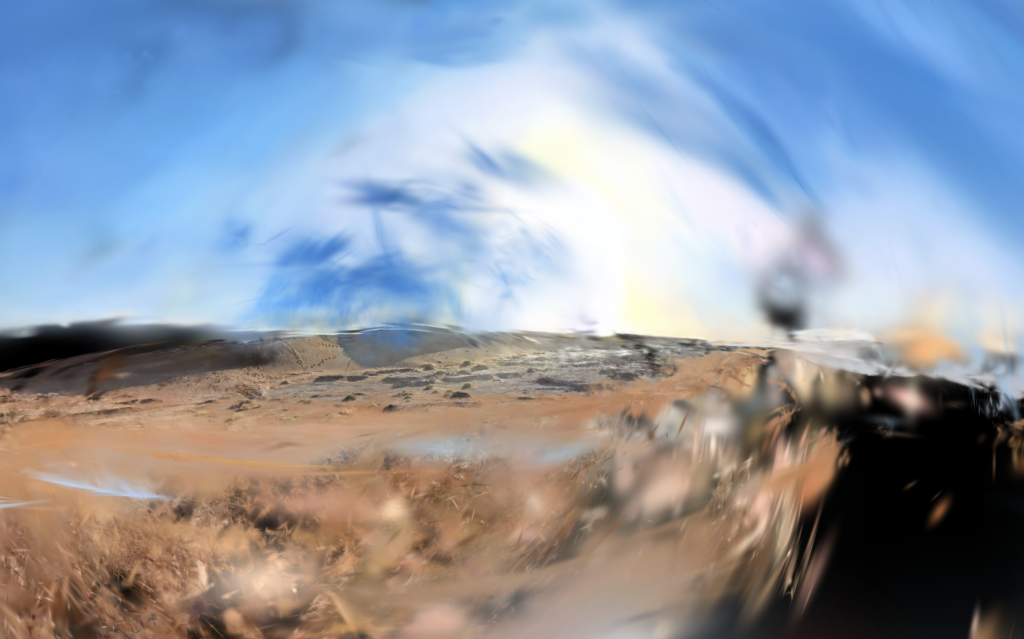
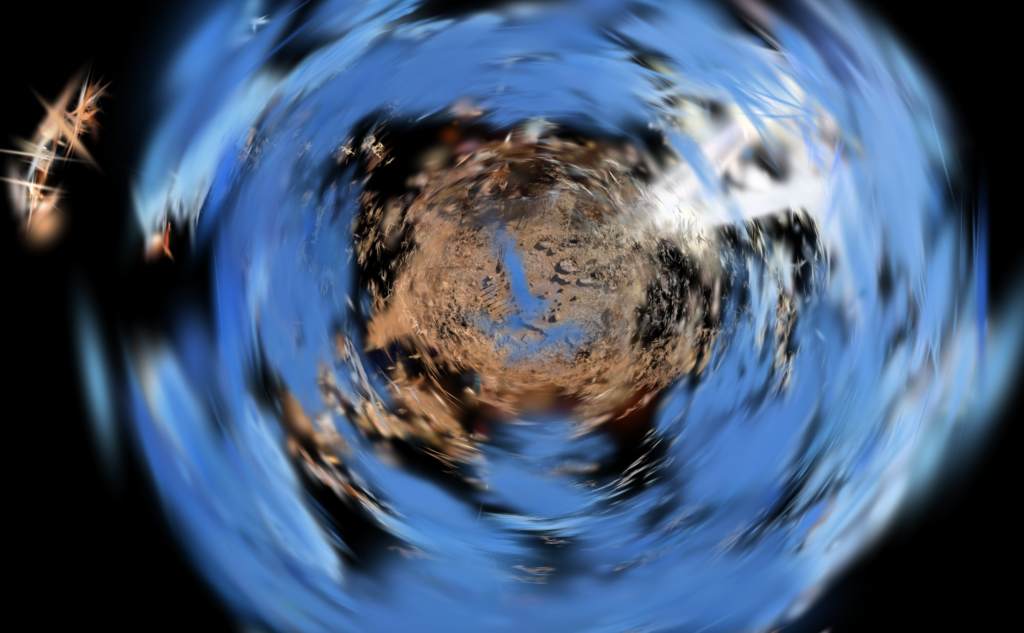
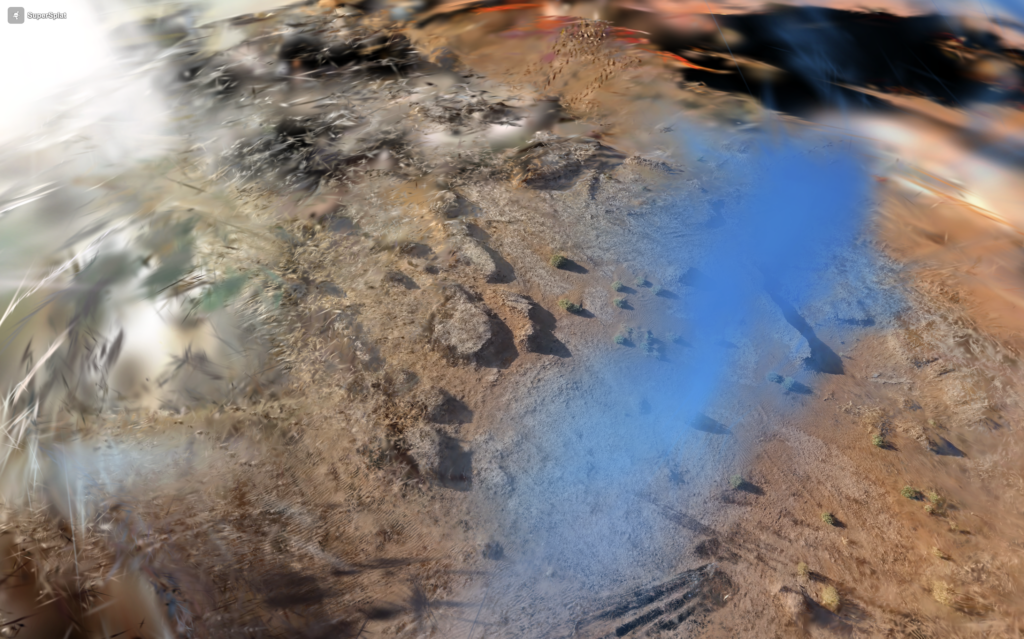
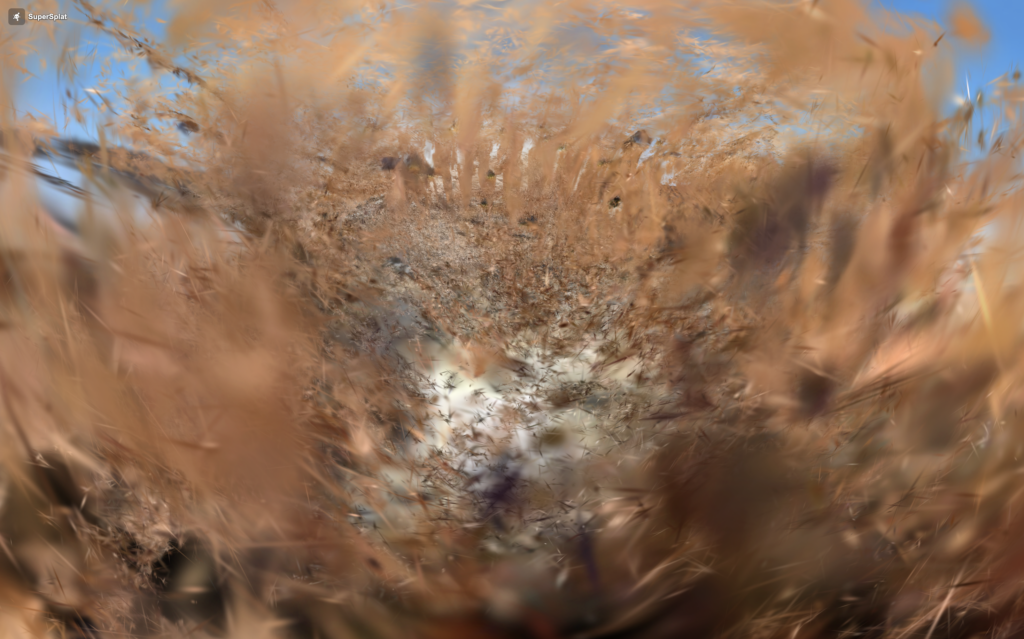
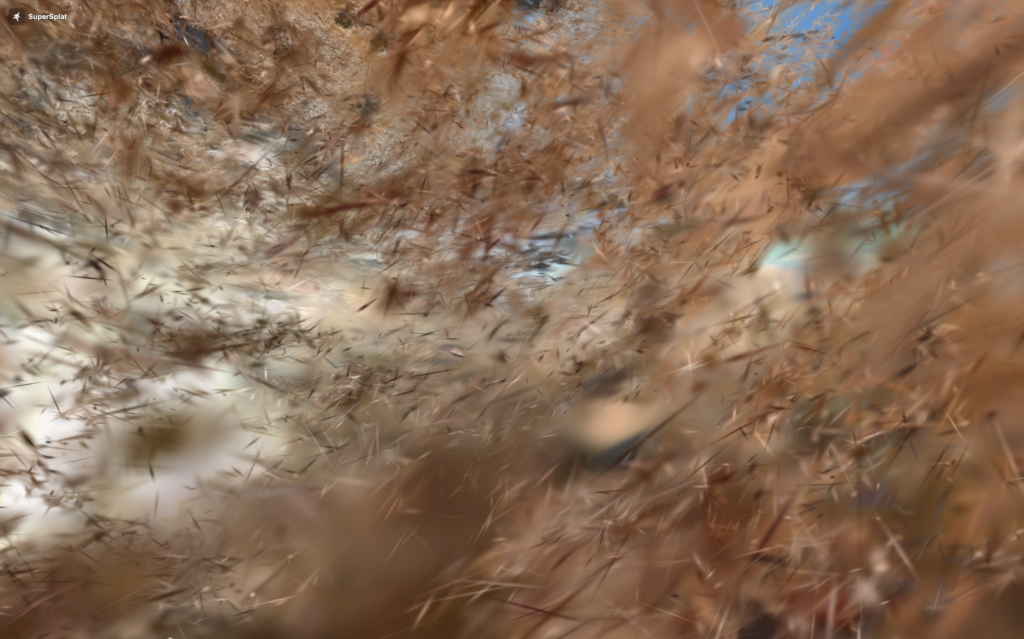
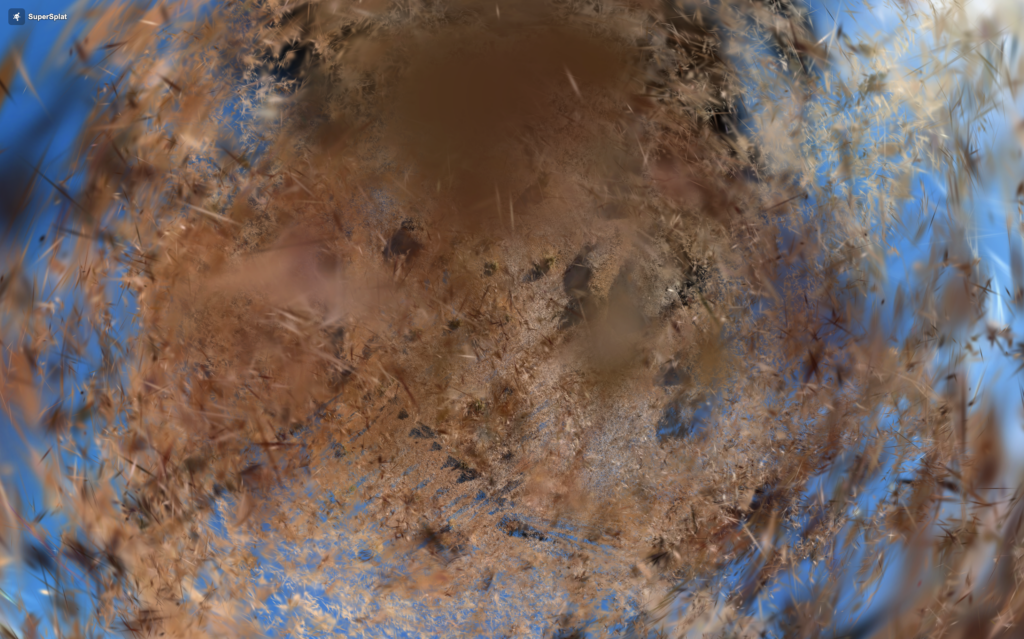
Le Gaussian Splatting reconstruit un lieu depuis un point de vue calculé. En dehors de la zone d’intérêt, une autre structure apparaît : un champ de particules arrangées pour simuler profondeur et parallaxe. Ce que l’algorithme ne parvient pas à représenter révèle son mode de fonctionnement.
—
Gaussian Splatting reconstructs a place from a calculated viewpoint. Outside the intended zone, another structure appears: a field of particles arranged to simulate depth and parallax. What the algorithm fails to represent reveals how it works.
1 — Out of frame
Abstract capture — out of field of interest | Unreal Engine Music: Ryuichi Sakamoto — disintegration (async)