Field notes — Port-Blanc, Penvénan, Côtes-d’Armor, Bretagne
→ English below
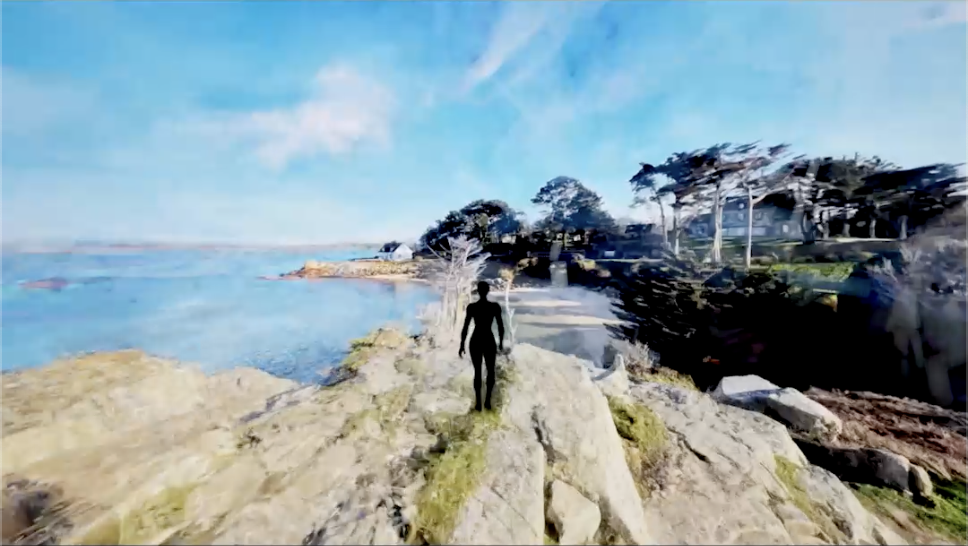
Enfin le printemps. Le sentier côtier au-dessus de Port-Blanc, reconstruit en scène 3D navigable par Gaussian Splatting, rendu en temps réel dans un moteur de jeu.
- L’avatar est en haut de la falaise — il peut regarder la côte, la mer vers l’horizon, se balader parmi les rochers et la végétation printanière. Un espace ouvert, entre terre et mer.
- L’avatar a un corps dans l’espace reconstruit : une échelle, une présence physique dans un lieu qui n’existe plus vraiment. Mais il n’a pas d’ombre. Corps stable, purement virtuel, face à une capture de la réalité instable et fragmentée. L’avatar donne une échelle et une présence — il ancre le visiteur dans l’espace, rend l’immersion possible.
- Les forces de particules répondent au passage de l’avatar — l’espace réagit au visiteur. Les splats se dispersent, révèlent leur nature de pixels de l’espace : la matière brute de l’archive.
- On peut s’écarter du sentier, explorer la falaise, voir l’intérieur des rochers — des espaces que la caméra a longés mais jamais traversés.
- Pour que l’avatar puisse se déplacer sur le terrain, j’ai dû ajouter des plateformes invisibles. Le sol de la reconstruction n’est pas un sol : c’est une image. Il a fallu construire une géographie praticable par-dessus la géographie capturée.
- Le dispositif permet de passer de la troisième à la première personne. En troisième personne, l’avatar nous projette comme sujet dans l’espace — on est dans le lieu. En première personne, le regard devient plus immersif : on peut s’arrêter sur un détail, s’approcher d’une surface, observer ce que la troisième personne survole.
Est-ce qu’on se promène dans un souvenir ? Que se passe-t-il quand un corps stable traverse un espace instable ?
Finally spring. The coastal path above Port-Blanc, reconstructed into a navigable 3D scene using Gaussian Splatting, rendered in real time in a game engine.
- The avatar stands at the top of the cliff — it can look along the coastline, toward the sea and the horizon, and wander among the rocks and spring vegetation. An open space, between land and sea.
- The avatar has a body in the reconstructed space: a scale, a physical presence in a place that no longer truly exists. But it casts no shadow. A stable body, purely virtual, facing an unstable and fragmented capture of reality. The avatar provides scale and presence — it anchors the visitor in the space, makes immersion possible.
- Particle forces respond to the avatar’s passage — the space reacts to the visitor. Splats scatter, revealing their nature as space pixels: the raw material of the archive.
- It is possible to leave the path, explore the cliff, see inside the rocks — spaces the camera walked alongside but never entered.
- For the avatar to move across the terrain, I had to add invisible platforms. The floor of the reconstruction is not a floor: it is an image. A walkable geography had to be built on top of the captured geography.
- The device allows switching between third and first person. In third person, the avatar projects us as subject into the space — we are in the place. In first person, the gaze becomes more immersive: one can pause on a detail, approach a surface, notice what the third-person view passes over.
Are we walking through a memory? What happens when a stable body moves through an unstable space?
1 — Traveling through the reconstructed scene
Coastal path reconstruction — Unreal Engine, particle forces via TouchDesigner
Interaction
Player interaction: Unreal Engine
Particle system forces: TouchDesigner — MIDI to OSC
Training
Method: Gaussian Splatting (PostShot)
Images: 1,020
Aligned: 785 (RealityCapture)
Splats: 1.6M
Capture duration: 4:47 min
360 POV frames: 277
Location: Port-Blanc, Penvénan, Côtes-d’Armor, Bretagne — outdoor / spring
Processing
Post-clean: none
Part of an ongoing research on navigable volumetric reconstructions and the limits of algorithmic capture.
Nicolas Mimault, Bagnolet / Paris · nmimault@gmail.com